Who
Killed James Forrestal? Part 2
Go to Part 1. Go to synopsis. Go to Part 3. Go to Part 4. Go to Part 5. Go to Part 6.
Signs of a Struggle?
The
first person to enter former Secretary of Defense James Forrestal's fully lighted
room at the Bethesda Naval Hospital after his fatal, late-night plunge from a
16th floor window saw broken glass on his bed. The Navy photographer who
took pictures of the room at some unknown time later took a picture of broken
pieces of what looks like either a petri dish or an ash tray on the ornate
carpet in the room, but in the photograph, the bed had nothing but a bare
mattress and a couple of bare pillows on it, not even the turned-back bed
covering that the nurse who saw the glass on the bed described. The two
photographs of the room, taken from different angles, also failed to show
either the slippers under the bed or the razor blade beside it that the nurse
saw. In fact, the barren room with nothing on the bed or any of the
furniture, no reading or writing material, no clothing, no spectacles, no pipe,
tobacco, or lighter, in short, no sign that James Forrestal or anyone else had,
shortly before, been a patient there, is clearly not the room as described by
the nurse, Lieutenant junior grade Dorothy Turner. (See photographs.)
The
scene that Navy corpsman chief John Edward McClain captured was not what a
proper police crime-scene photographer would have captured. The room had
been stripped down and scrubbed up, except that the cleaners seem to have
overlooked the clear pieces of glass two feet, or so, from the foot of the bed.
A suspicious police investigator, encountering this broken glass on the bed and
the floor and noting the bathrobe cord tightly tied around Forrestal's neck,
might well have concluded that these were signs of a struggle, quite
inconsistent with the quick conclusion of suicide by the county medical
examiner and the inferences drawn by the news accounts.
Secret Report Finally Made
Public
This new
information on James Forrestal's untimely death, never reported before
anywhere, is taken directly from the investigation of the review board convened by the commander
of the National Naval Medical Center, Rear Admiral Morton D. Willcutts, on the day after Forrestal's May 22, 1949,
death. The board, made up of five Navy Medical Corps officers junior to
Admiral Willcutts and one retired Medical Corps
captain had finished hearing and recording the testimony of all witnesses–all
of whom were also members of the Navy Medical Corps on duty at the Bethesda
Naval Hospital–on May 31, 1949. The "proceedings and findings"
of the board were officially signed off on by the Commandant of the Potomac
River Naval Command on July 13, 1949, but not until October 11 was a less than
one page, uninformative 5-point "Finding of Facts" released to the
public. Interestingly, that release did not conclude that Forrestal had
committed suicide, but the press left us with the impression that it had.
The Review Board investigation itself remained secret until April 6 of 2004
when the author, on his third Freedom of Information Act try, the first two of
which were to the National Naval Medical Center, received the report from the
Navy's Judge Advocate General's office.
Forrestal’s
body had been found on the roof of the second deck of the Bethesda Naval
Hospital at around 1:50 AM on Sunday. The board met at 11:45 AM on
Monday, May 23, and spent only 45 minutes total, visiting the morgue to
identify the body, the site 13 stories below where Forrestal had landed, room
1618 where Forrestal had been hospitalized for some seven weeks, and room 1620,
the diet kitchen across the hall out of whose window Forrestal had apparently
fallen. A lunch break was taken from 12:30 to 1:30 and the board members
then conferred among themselves until 2:18, when they adjourned for the
day.
Photographers First
The
first two witnesses called when the board convened the next morning were the
photographer who took pictures of the body and the photographer who took
pictures around the 16th floor area. It is of some
interest that two photographers were required for this task. Of even
greater interest is that, quite properly, the time when the pictures of the
body were taken is firmly established by questioning, but the board exhibits a
very curious lack of curiosity as to when the second set of pictures, the ones
inside the hospital, were taken.
After
establishing that “Harley F. Cope, junior, Aviation photographer’s mate first,”
had “been called upon recently to take some pictures” and having elicited from
Mate Cope what the nature of the pictures were, this question is addressed to
him:
Q. Can you tell us at what time you arrived on the
scene and at what time you took the pictures?
A. Yes, the pictures - that series of pictures were
taken between three and three fifteen. The last picture was taken at three
fifteen as a matter of fact.
The
second witness, “John Edward McClain, hospital corpsman chief, U.S. Navy,” was
also asked if he was “called upon recently to take some pictures” and asked to
identify them, but the follow-up question establishing the important fact of
when he was called upon and when he took the pictures never comes. It is
apparent that enough time had been permitted to elapse for Forrestal’s room to
be transformed from the one that Nurse Turner described to the one that
Corpsman McClain photographed. That the review board failed to establish
just how much time that was looks to be more than inadvertent. When we
look carefully at the windows in the photographs of the room, we see that
bright sunlight is streaming in. The sun is about as high in the sky as it gets
in May at the latitude of the Washington, DC, area. One can surmise that
at least eight hours had passed between Forrestal’s fall and Corpsman McClain’s
photographic work. Why was it necessary to let so much time
pass?
Though
they must have taken a look at the photographs and noticed the barren room and
the bright sunlight in the pictures, the members of the review board failed to
note the contradiction in the later testimony of Lieutenant junior grade
Francis Whitney Westneat when he said that, “... the
Navy photographers (plural) arrived at three fifteen and finished their work at
about three twenty-five....”
Not only
do the questioners fail to establish when the second photographer actually did
his work, but in using the passive voice in their initial questions to each of
the photographers, they also fail to inform us as to exactly who called upon
these photographers to take these pictures. Who was in charge of things,
of the investigation, if you will, from the time Forrestal was
found dead until the board began its work at 11:45 of the next morning, some 34
hours later? If we could know that we might also be able to learn who was
responsible for laundering the crime scene of Forrestal’s room.
That
Corpsman McClain was, to some degree, treating what he was shooting as a crime
scene comes out in his volunteered remarks about one of the pictures he is
asked to describe: “This is out of focus. We were shooting for finger
prints which we were requested to get and that is what we have, sir.”
The
board never asks who requested the pictures of fingerprints or what those
pictures turned up. Since the board never asks who that person was, that
key investigator is never examined by the board.
In that
same long response identifying his photographs, McClain reveals the existence
of the broken glass: “The fifth picture is a picture of a rug with some broken
glass on it, taken approximately two feet from the end of the bed. We
were unable to get any identifying marks except the rug; couldn’t pick up the
bed because the glass wouldn’t show. It was room sixteen
eighteen.”
Perhaps
the mystery investigator who ordered up the fingerprints also made some effort
to determine how the glass came to be broken, but the board members, none of
whom, as medical men, seem to have any background in the investigation of
crimes, have nothing to say about it.
Their
curiosity about the broken glass was no greater when they questioned Nurse
Turner next to last on the third day of the hearing.
Q. What were your particular duties on the night of
May twenty-first?
A. Usually before quarter of two I go down to tower
eight before I write the captain’s log and I had left tower twelve and went
down to tower eight and I asked the corpsman how everything was and he said he
just gave a man a pill. I happened to look up at the clock. It was
just about one fourty-four (sic). I sat there
in a chair for a minute and then I heard this noise. It was a double thud
and I said what was that. I said “It sounded like somebody fell out of
bed you better check the wing in front” and he went to check the beds and said
it was alright and so I said “I’ll check the head” and sent him to tower seven
to see if it was something down there. That’s when I walked in the
bathroom on tower eight. I looked out the window. I just remember
thinking in my mind, “Oh my God, I hope he isn’t mine” and I ran up to tower
twelve and told the corpsman to check on Colonel Fuller’s room so he walked
into his room and I walked into room twelve thirty opposite his room and looked
out the window from there and could see a body distinctly. It was then I
really realized it was a body and I thought of Mister Forrestal. So
I went up to tower sixteen and told Miss Harty there was a man’s body outside
the galley window and he wasn’t mine. We both went into his room and he
wasn’t there and we noticed the broken glass on the bed and looked down and
noticed the razor blade and told him he was missing [sic] and she said it was
one forty-eight. Then I walked over towards the galley and noticed the
screen was unlocked. That’s about all.
Examined by the board:
Q. When you found out the body was not that of one of
your patients what made you think of Mister Forrestal?
A. I knew he wasn’t mine and I knew that Mister
Forrestal was up there and was being watched.
Q. You said you saw his slippers and a razor blade
beside them; where did you see them?
A. The bed clothes were turned back and towards the
middle of the bed and I looked down and they were right there as you get out of
bed.
Q. And the razor blade was lying beside the
slippers?
A. Yes it was.
Q. Did you notice any blood on the bed?
A. No, I didn’t see any and the razor blade was dry;
there wasn’t anything on that. I remember looking and there wasn’t
anything on the glass either.
Q. Where was the bathrobe?
A. I didn’t see his bathrobe.
Neither the recorder nor the members of the board desired
further to examine the witness.
The board informed the witness that she was privileged to
make any further statement covering anything relating to the subject matter of
the investigation which she thought should be a matter of record in connection
therewith, which had not been fully brought out by the previous
questioning.
The witness said she had nothing further to state.
The witness was duly warned and withdrew.
A few
comments are in order.
Notice
that when she first mentions them, Nurse Turner speaks of the broken
glass and the razor blade as though she has told these people,
or at least someone in authority, about these things before. Once again
we are made to wonder who was in charge in the immediate aftermath of the death
and what he learned from the witnesses. The corpsman who was supposed to
be monitoring Forrestal and first noticed him missing from the darkened room,
Robert Wayne Harrison, was also not called to testify until the third day of
the hearing (Wednesday). Surely someone had interviewed him earlier, but
it was not part of the official record.
The
questioner said, “you said you saw his slippers and a razor
blade...”
The
astute reader will notice that she has said nothing about slippers. Maybe
the transcriber just messed up, but at least as likely, some prior questioning
had gone on that was not officially recorded. And why are they interested
in the slippers and the razor blade when it is the glass, more than anything
else, which should intrigue them? They don’t even ask if she saw broken
glass anywhere else, like on the floor, where they have already seen
photographs of it. They had previously asked Corpsman Harrison if he had seen
any glass on the floor, and he had responded in the negative (but he apparently
never turned on the lights).
Nurse
Regina M. L. Harty, who accompanied Nurse Turner to the room, had been
interviewed earlier, but she was never asked to describe what she saw in the
room.
The
final question about the bathrobe might have some real significance. We
wonder which of the board members asked it, and if he might have been on to
something. Unfortunately, we will never learn who played what role in the
questioning because the individual questioners on the board are never
identified. He is just a “Q.”
Although
the “cord” found tied tightly around Forrestal’s neck is commonly referred to
as his bathrobe cord, no official connection is ever made between that cord and
his bathrobe. He was wearing only his pajamas when he fell from the
window. The cord appears in the list of exhibits, but the bathrobe does
not. This question of Nurse Turner represents the only attempt by the
board to locate the bathrobe, perhaps to see if it was missing a
belt.
The Key Missing Exhibits
Some
much more important things than Forrestal’s bathrobe were missing from the
exhibits, though. Have a look at the complete list, dear reader, and see
if you notice what they are:
Introduced
on Page No.
Pictures of body of deceased,
Exhibits 1A through 1J .............................................................…......………
2
Photographs of Rooms sixteen eighteen and sixteen twenty and
outside of building (illegible), National Naval Medical Center,
Bethesda, Maryland,
Exhibits 2A through
2K...................................................................………….4
Clinical record of the deceased, Exhibit
3.....................................................................8
Bathrobe cord, Exhibit
4...........................................................................…..............37
Photographs of external injuries taken immediately preceding autopsy,
Exhibit
5........................................................................................….…..…................55
Letter of Doctor William C. Menninger, Exhibit
6................................…....................57
Letter of Doctor Raymond W. Waggoner, Exhibit
7....................................................57
That’s
right, there’s no autopsy report, a pretty serious omission. Defenders of
the investigation might respond that the autopsy doctor, as we shall see, was
questioned at length and asked many key questions, revealing that in his
opinion Forrestal was not choked to death before being thrown out of the
window, but these are no substitute for the autopsy report itself. One
can only wonder why it was left out. Possibly germane to this omission is
the fact that the author’s FOIA request for all materials connected with the Willcutts Report was not completely honored by the Navy JAG
office. The first set of exhibits, the 10 photographs of the body as it
lay on the third floor roof were held back, as were an unknown number of
photographs taken of Forrestal’s external injuries taken just prior to the
autopsy. The reason given was that “...the unauthorized release of this
information would result in a clearly unwarranted invasion of personal privacy
with respect to Mr. Forrestal’s surviving family members (5 U.S.C.552 (b)(6),
as amended).”
The JAG
office informed me that I could challenge the ruling with a formal letter sent
within 60 days, and I did so, on the basis that no family member who knew him
and could be counted as a loved one or a “surviving family member” was still
alive (He has one grandchild who was born many years after his death and is now
only of college age.). On September 14, 2004, I finally received a
response. Here is the key paragraph:
"Please
be advised that these exhibits [1, 4, and 5] are missing from the original
investigative report. Due to an administrative error you were informed on
April 6, 2004, that these exhibits were withheld out of respect to Mr.
Forrestal’s surviving family members."
It would
appear to this humble observer that the Navy legal team’s initial error was
tactical rather than administrative.
Readers
of the first installment of “Who Killed James Forrestal?” should also notice
the missing props that played such a key role in convincing the public that
Forrestal had killed himself. For the others, here are the key passages
from the front-page article in The New York Times of Monday,
May 23, 1949:
Forrestal
Killed in 13 Story Leap
Nation is Shocked
He Was a War Casualty as If He Died at Front, President Declares
Copied a Poem on Death
Had Seemed to Be Improving
in the Naval Hospital–Admiral Orders Inquiry
Washington May 22 - James Forrestal, former Secretary of
Defense, jumped thirteen stories to his death early this morning from the
sixteenth floor of the Naval Medical Center.
Suicide had apparently been planned from early
evening. He declined his usual sleeping pill about 1:45 this
morning. A book of poetry beside his bed was opened to a passage from the
Greek tragedian, Sophocles, telling of the comfort of death.
........
The plunge that caused Mr. Forrestal’s death occurred at 2
A.M. and hospital authorities announced it with a brief statement two hours
later.
Pushed Open a Screen
The hospital said that Mr. Forrestal had left his room, No.
1618 in the white granite tower of the hospital, and had gone to a diet kitchen
nearby. There, clad in a dressing gown, he pushed open a screen held only
by thumb latches and plummeted to the third floor projection after hitting a
narrower projection at the fourth floor.
The sound of the fall was heard by Lieut. Dorothy Turner,
the nurse on duty on the seventh floor almost immediately after a Medical
Corpsman’s check of Mr. Forrestal’s room disclosed he was missing. An
investigation led to the discovery of the body on the roof of the passageway
leading from the third floor of the main building.
There were indications that Mr. Forrestal might also have
tried to hang himself. The sash of his dressing-gown was still knotted
and wrapped tightly around his neck when he was found, but hospital officials
would not speculate as to its possible purpose.
Mr. Forrestal had copied most of the Sophocles poem from
the book on hospital memo paper, but he had apparently been interrupted in his
efforts. His copying stopped after he had written “night” of the word
“nightingale” in the twenty-sixth line of the poem.
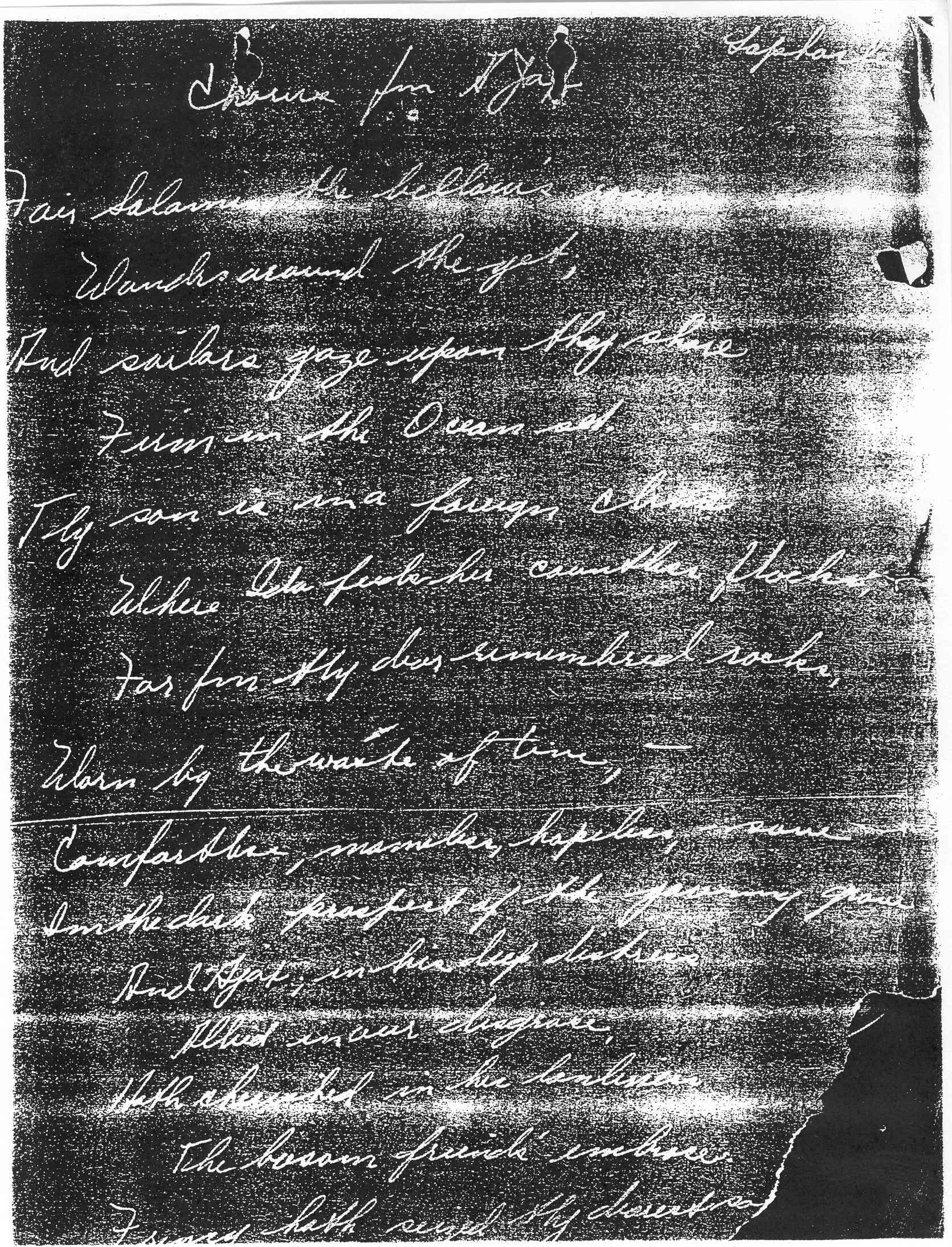
The book was Anthology of World Poetry, bound in red
leather and decorated in gold. A red ribbon bookmark was between Pages
278 and 279 where “Chorus from Ajax” appears.
.........
He was widely denounced by persons who felt that he favored
the Arabs over the Jews, and Mr. Forrestal was said to be particularly
distressed by a statement that “he cared more for oil than he did for the
Jews.”
........
Rear Admiral Leslie Stone
Adm. Stone gave this account of the circumstances that
enabled Mr. Forrestal to elude the attendant early this morning.
Commander R.R. Deen, a staff
psychiatrist, was asleep in the room next to that of Mr. Forrestal. The
attendant, Hospital Apprentice R.W. Harrison made his visit to Mr. Forrestal at
about 1:30 and found him apparently asleep. On his 1:45 check he found
Mr. Forrestal awake. Asked if he wanted a sleeping pill, Mr. Forrestal
said he did not.
Apprentice Harrison then went to Commander Deen’s room to report that Mr. Forrestal had declined to
take a sedative. Back at 1:50, he found that his patient was not in his
room.
Commander Deen was immediately
roused and a check of the room begun. A few minutes later the seventh
floor nurse, Lt. Turner, reported the sound of Mr. Forrestal’s body striking
the third floor roof.
Admiral Stone said that Mr. Forrestal had improved to the
point where he was being allowed to shave himself and that belts were
permissible on his dressing gown and pajamas. It had been accepted that
continued treatment would have brought Mr. Forrestal to complete recovery in a
matter of months.
So where
were the poetry anthology and the memo page with the transcribed lines from
“Chorus from Ajax” in the list of exhibits? Actually, the handwritten
page was included among the materials that the author received from the Navy,
but none of the witnesses mention having discovered it or the book in
Forrestal’s room, and no one on the review board asks anything about the
circumstances of their discovery. Nurse Turner, the most likely candidate
to have seen them first, if, in fact, they were ever in the room, mentions only
the broken glass, the turned-down bed clothes, the razor blade, and, with
prompting from the board, Forrestal’s slippers. The book and the
transcription were absolutely vital in the selling of the story that Forrestal
took his own life, but they seem to have materialized out of the ether
(Speaking of ether, another thing we learn from the Willcutts
Report, for what it is worth, is that Forrestal complained on a number of
occasions of a strong ether smell in his room.). On the other hand,
broken glass was most assuredly discovered in the room by two separate
individuals, one of whom captured it photographically, and it has taken 55
years for that fact to reach the American public (Actually it remains to be
seen whether the salient facts surrounding Forrestal’s death will ever reach
any significant portion of the American public. Those who were content
for the Report to remain secret all these years will hardly be inclined to
publicize its findings and its shortcomings.).
Something
else that is notable about the account in The Times is the degree of
detail about the goings on in the hospital in the minutes before and after
Forrestal’s fatal plunge. This is information that could only have come
from Apprentice Harrison, Commander Deen, and Lt.
Turner. Someone had clearly taken charge of the investigation right off
the bat to elicit this information from them. For lack of any other name,
that of the commanding medical officer of Bethesda Naval Hospital, Rear Admiral
Leslie Stone, the man who gave the information to the press will have to
do. Yet, as we shall see, when the board questions him they ask him
nothing about his actions in the wake of the Forrestal death.
Forrestal’s Guard Queried
Apprentice
Harrison plays such an important role in Forrestal’s last few minutes among the
living that his testimony is produced here in its entirety:
Examined
by the recorder (Lieutenant Robert F. Hooper, Medical Service Corps, U.S.
Navy):
Q. State your name, rate and present station.
A. Robert Wayne Harrison, junior, hospital
apprentice, U. S. Navy, Naval Medical Center, Bethesda, Maryland.
Q. Harrison, what were your specific duties on the
night of May twenty-first?
A. My specific duties were to take care of Mister
Forrestal.
Q. What time did you go on duty?
A. I went on duty at eleven forty-five p.m.
Q. Whom did you relieve?
A. Price, hospital corpsman?
Q. Would you tell the board what happened from the
time you took over the watch at eleven forty-five until the time that you
discovered Mister Forrestal was missing?
A. When I took over the watch at eleven forty-five
Price whom I relieved told me that Mister Forrestal was still up in his room
and that he had been walking around; that he had been reading. Since I
didn’t know Mister Forrestal personally, (I had been on the night before, and
when he woke up the next morning I didn’t get to talk to him very much, I
didn’t know him personally), he introduced me to him and he was very friendly
and said “Hello” to me.
Q. How many times did you speak to Mister Forrestal
between the time you took over the watch and the time he was missing?
A. Approximately three or four times.
Q. Did you notice anything unusual about Mister
Forrestal’s behavior during that time?
A. No, sir, I didn’t.
Q. Did he say anything to you that would lead you to
believe that he was in any way disturbed?
A. No, sir, he didn’t.
Q. At what time did you last see Mister
Forrestal?
A. It was one forty-five, sir.
Q. Where was he then?
A. He was in his bed, apparently sleeping.
Q. Where were you at that time?
A. I was in the room when I saw him.
Q. Did you leave the room at that time?
A. Yes, sir, I did.
Q. Where did you go?
A. I went out to the nurse’s desk to write in the
chart, Mister Forrestal’s chart.
Q. At what time did you become aware of the fact that
Mister Forrestal was missing?
A. At approximately one-fifty a.m.
Q. Had you previously spoken to the doctor regarding
Mister Forrestal?
A. Yes, sir, I had.
Q. At what time was that?
A. That was just before one forty-five before I went
back into his room to check to see what he was doing, to see if he was asleep
or resting.
Q. And then you left the room and went out to the
nurse’s desk?
A. To write in the chart, yes, sir.
Q. What did you do when you discovered Mister
Forrestal was missing?
A. When I went back into the room after I had
finished writing in the chart, I went over to my chair where he had been
sitting while I was in the room before and since it is dark in the room, very
dark, my eyes had to become accustomed to the light before I could see
anything. There is a chair sitting directly in front of the night light
and it is very hard to see anything at all when you first walk into the room so
I went over and started to sit down in the chair; by that time I could see enough
to see that he wasn’t in his bed. The first thought that came to my mind
was maybe he had gotten up and gone into the head and at the same moment the
corpsman on duty, Utz, came to the door and told me I had a phone call out at
the desk. I told him Mister Forrestal was gone. I went out to the
desk and answered the phone call. It was Bramley, the night
Master-at-arms of the Neuropsychiatric service. Bramley asked me if
Mister Forrestal was alright. I said that I didn’t know, that he wasn’t
in his bed and he told me to make a thorough check and to find out for sure
where he was. So I went back into the head, looked in the closet, any possible
place in the room, and on my way back out in the hall back to the phone I
looked into the galley and I didn’t see him in there, either. So I went
back to the phone and told Bramley that he was not there.
Examined by the board:
Q. Just prior to discovering that Mister Forrestal
was missing did you hear any unusual noises coming from the vicinity of the
diet kitchen?
A. No, sir, I heard nothing.
Q. Were you close enough to
the diet kitchen to hear if there had been any unusual noises?
A. Yes, sir, I definitely would have.
Q. What is your regular assignment in the
hospital?
A. I was on night duty on ward 6-D, a
neuropsychiatric ward.
Q. How long have you been there?
A. Approximately two months, a little over two
months, sir.
Q. How long have you been assigned to the
neuropsychiatric service?
A. A little over two months, sir.
Q. How many times did you say you stood watch on
Mister Forrestal?
A. Part of Friday night and I took the regular watch
on Saturday night.
Q. Did Mister Forrestal do very much wandering about
his room or corridor Saturday night?
A. He was walking around his room and he did follow
me out to the diet kitchen when he asked me for some orange juice and then once
after that he was out of his room to drink a cup of coffee.
Q. Did he go to the diet kitchen for the
coffee?
A. Yes, sir, he did.
Q. Were you with him
then?
A. No, sir, I was not.
Q. He served the coffee himself?
A. No, sir, the corpsman on duty, Utz, was bringing
coffee up in a coffee pot at that time. I was out writing my chart
and he went past the desk where I was sitting and entering in the chart.
He went out towards the galley with his pot of coffee and I heard him mention
Mister Forrestal’s name and say something to him and ask him if he would like a
cup of coffee. Mister Forrestal said “Yes” and then I heard a noise which
would signify he was giving him a cup of coffee and right after that I got up
and went out to the diet kitchen. He was coming out with his coffee in
his hand. He handed me the cup of coffee and said he was all finished
with it. He said I could put it in the galley.
Q. About what time was that?
A. That is one time I don’t remember.
Q. How was he dressed?
A. He was in his pajamas, sir.
Q. Did he have a bathrobe on or not?
A. No, sir.
Q. Did you give Mister Forrestal any medication at
all that night?
A. No, sir, I didn’t.
Q. Did he talk to you very much that night?
A. No, he didn’t.
Q. Didn’t he ask you about yourself and where you
came from and so on?
A. No, sir, he didn’t say much except when I first
came in and was introduced to him. That was when he said “Hello” to
me. When I asked him if he wanted his sleeping tablets he told me no, he
thought he could sleep without them.
Q. Was your station inside Mister Forrestal’s room or
was it outside the door?
A. I don’t exactly understand what you mean by that,
sir.
Q. Were you directed to sit
in his room while you had the watch most of the time or could you sit at the
nurse’s desk?
A. I was supposed to be in the room except when I
went out to make entries in his chart or get something for Mister
Forrestal.
Q. Were the lights on in
Mister Forrestal’s room when you took over the watch - the overhead
lights?
A. No, sir, not the overhead lights; just the night
light.
Q. Did you notice a broken ashtray any time during
your tour of duty in Mister Forrestal’s room?
A. No, sir, I didn’t.
Q. When you were at the nurse’s desk is it possible
for a person to go into the diet kitchen without your observing him?
A. I couldn’t have seen him.
Q. Did Mister Forrestal appear cheerful or depressed
in the time that you observed him?
A. He appeared neither, sir.
Q. Did Mister Forrestal do any reading?
A. Not while I was on watch, sir.
Q. After you discovered Mister Forrestal was gone did
you go into the galley?
A. About fifteen or twenty minutes afterwards, yes,
sir.
Q. Would you describe the condition of the window in
the area at the time that you were in there, in particular whether the screen
was locked or unlocked?
A. The screen was unlocked at that time, sir.
Q. Were there any
attachments to the radiator?
A. I saw none if there were.
Q. Did you notice any marks on the window sill?
A. Sir, at that time I was in such a state that I
didn’t notice any marks on the window sill.
Q. You did state earlier that you had looked into the
galley but no one was there?
A. Yes, sir.
Q. You had no reason to examine the galley further?
A. No, sir, I didn’t.
Q. Did you see Mr. Forrestal’s body at any time
later?
A. Yes, sir, I did, in the morgue.
Q. Did you recognize the body as that of Mister
Forrestal?
A. Yes, sir.
Neither the recorder nor the members of the board desired
further to examine this witness.
The board informed the witness that he was privileged to
make any further statement covering anything relating to the subject matter of
the investigation which he thought should be a matter of record in connection
therewith, which had not been fully brought out by the previous
questioning.
The witness said he had nothing further to state.
The witness was duly warned and withdrew.
Notice,
first, that there is a difference in the explanation Admiral Stone gave
to The Times from that of Apprentice Harrison for the latter’s
absence from the room at the time of Forrestal’s disappearance. According
to Stone, Harrison had left the room to inform Dr. Deen
that Forrestal had declined his usual sleeping pill. Harrison’s
explanation here, though, is that he had simply gone down the hall to make
routine entries in the log book at the nurse’s desk. Actually, Dr. Deen in his testimony did say that Harrison had awakened
him a few minutes before to report that Forrestal was not sleeping and that he
had told Harrison that he should remind Forrestal that he should take a pill if
he was having trouble sleeping. Harrison had then returned to Forrestal’s room
before his last trip down the hall to make his log entries.
Second,
the account given by Townsend Hoopes and Douglas Brinkley in Driven
Patriot, the Life and Times of James Forrestal (Alfred A. Knopf, 1992)
is seen to have some serious flaws:
At one forty-five on Sunday morning, May 22, the new
corpsman looked in on Forrestal, who was busy copying onto several sheets of
paper the brooding classical poem “Chorus from Ajax” by Sophocles, in which
Ajax, forlorn and far from home contemplates suicide. The book was bound
in red leather and decorated with gold.
.......
In most accounts of what happened next, it is said that the
inexperienced corpsman “went on a brief errand.” However, Dr. Robert Nenno, the young psychiatrist who later worked for Dr.
Raines, quotes Raines as telling him that Forrestal “pulled rank” and ordered
the nervous young corpsman to go on some errand that was designed to remove him
from the premises. (pp. 464-465)
According
to Apprentice Harrison, only the dim nightlight was on in Forrestal’s room from
the time that he went on duty at 11:45 p.m. until the patient turned up missing
at 1:50 a.m., and Forrestal did no reading.
Assuming
Dr. Nenno was telling the truth, this account also
seriously calls into question the probity of the psychiatrist in overall charge
of Forrestal’s care. The head psychiatrist in charge of Forrestal’s care,
Captain George Raines, depicts Forrestal as scheming to get Harrison out of the
way so he can commit suicide, but the doctor’s story is flatly contradicted by
the Harrison testimony, testimony with which Dr. Raines had to have been
thoroughly familiar when he gave his account to Dr. Nenno.
Hoopes
and Brinkley do prove to be correct with their revelation–not found in any
previously published account of which the author is aware–that the guard on
duty was new to the job. Here we find that he was spending his first full
night on the Forrestal detail, having spent part of Friday night on duty.
The significance they read into that fact, however, that it made him easily
manipulated by a suicide-bound Forrestal, proved to be off the mark. If,
on the other hand, Forrestal was murdered on orders of the powers that be,
Harrison’s newness to the job might indicate that he was part of the plot,
brought in from outside to help carry out the deed during the hours when
Forrestal was most vulnerable. To allow the accomplice time to get to
know Forrestal as a person would have jeopardized the mission, and it would
have looked really bad if the deed had been pulled off within a few days of
Forrestal’s admission into the hospital when he was ostensibly under heavy
guard, expressly to prevent suicide.
The
timing of the board’s question, giving Harrison the opportunity to establish
that he had worked previously in neuropsychology elsewhere in the hospital,
seems almost to have as its purpose the forestalling of such speculation.
We don’t know if Harrison was, in fact, telling the truth on this point.
Furthermore, he could have been an operative all along, working for one of the
more clandestine branches of the government. It would have been helpful
if the board had established why the regular night-shift attendant was not
there. Hoopes and Brinkley say that he had gone AWOL on a drunken bender,
but this is neither corroborated by the official inquiry nor is it
contradicted.
A couple
more revelations in the Harrison testimony are of interest. We find out
that the regular station of Forrestal’s attendant was not just outside the door
of his room, as one might assume, but in the room itself. Dr. Raines and
the other psychiatrists in their testimony make a big deal out of relaxed
restrictions on Forrestal being an important part of his “recovery”
process. At the same time, they have a person violating his privacy on an
almost permanent basis. The picture that comes across is more of
Forrestal as a prisoner than as a patient. We discover further that those
detailed periodic log entries that make up most of the bulk of the exhibits to
the Willcutts Report were made at the nurse’s desk
down the hall and that from that location one could not see anyone going from
Forrestal’s room to the kitchen across the hall with its unprotected
window. It almost makes a farce of the story that when Forrestal was
first admitted and his mental state was bad, precautions against suicide were
tight, but were loosened only as his condition improved. Furthermore, we
learn from other testimony that immediately upon admission to the hospital,
Forrestal was sent immediately to the 16th floor room even
though “security screens” would not be installed on the room’s windows for
several more days. Recall, as well, the one clear picture that we have of
one of these “security screens” and we must really wonder how much of a hindrance
they would have been to anyone bent on suicide. The screen is already
half out of the window. The room pictures also reveal Venetian blinds on
the windows with long cords hanging down from them and radiators beneath the
windows. The cords as a noose and the radiator as a perch from which to
jump look to be almost tailor-made for suicide by hanging. One must
really wonder whether the good doctors at Bethesda ever really considered
Forrestal much of a suicide threat or if they did, whether they were expected
to make much of an effort to prevent it.
The Misnamed Witness
The
testimony of the witness who followed Harrison on the stand, but was relieved
by him on the night of Forrestal’s death, is perhaps even more intriguing than
Harrison’s, and it is also reproduced here in full:
Examined
by the recorder:
Q. State your name, rate and present station.
A. Edward William Price, hospital apprentice, 339 78
55, U.S. Naval Hospital, National Naval Medical Center, Bethesda,
Maryland.
Q. What are your regular duties at the Naval
Hospital?
A. Taking care of neuropsychiatric patients.
Q. How long have you been taking care of
neuropsychiatric patients?
A. Fifteen months, sir.
Q. What were your specific duties on the night of May
twenty-first?
A. I had the watch on Mister Forrestal from four
until twelve o’clock midnight.
Q. During the time that you had the watch on Mister
Forrestal did you notice anything unusual about his behavior.
A. Yes, sir.
Q. Will you tell the board what this unusual behavior
was during the watch?
A. Well, sir, at twenty-one ten he started
walking the room and it didn’t seem odd at twenty-one ten but when he was still
walking the floor at twenty-two hundred that was the first time he had ever
walked the floor that long and he was walking the floor for a period of two
hours and fifty minutes before I went off watch at twenty-four hundred.
And another thing was he went into the doctors’ room adjoining his room and he
raised the blinds, I would say that was–I don’t know exact time–around twenty
hundred and he raised the blinds and raised the window and at the time I was at
the desk. We had orders we could stay at the desk until twenty-one
hundred so long as we checked on him; so I went back to the doctors’ room and
the patient was standing at the window. He had raised the bottom part of
it as far as it would go. When I walked in the room he jumped
aside. He said “Price, I raised that window. If it gets you in any
trouble close it” so he went back through the head and closed the door so I let
the blind down and walked out of the room. Just as I got to the door I
heard the door to the head open again. He stuck his head out so I went
back and closed the head door and locked it and I went back to the desk.
I didn’t make any note of it because he has opened windows several times
in his own room and the doctors’ room. Only difference was I am usually
there with him when he does it. Other than that there was nothing odd
that he done that I can think of.
Q. How long had you stood watch on Mister Forrestal
previous to this particular night?
A. Well, sir, I took over the watch the third day he
was up there.
Q. Do you know the date that was.
A. I’d say it was the fifth of April.
Q. And you had stood watches continuously on him
since that date?
A. Yes, sir, I had eight in the morning to four in
the afternoon, then I went from there to twelve to eight, stood that for two
weeks, then went on four to twelve. I have been on four to twelve for a
little over three weeks.
Examined by the board:
Q. These occurrences that you have just related in
regard to Mister Forrestal’s behavior on that night, did you consider them
sufficiently unusual to report them to the doctor?
A. No, sir, I reported his walking the room to Doctor
Deen and I put it in the chart and then Doctor Deen asked me how come the door was locked back there and I
told him I thought I better lock it being as he raised the blind.
Q. Did you attach any particular significance to this
type of behavior?
A. No, sir, I didn’t at the time.
Q. Had you seen him in the past do things
similar?
A. Well, sir, he several times did walk the
room. He hated light and walked over to the window shades and if they
were open a little too far he would pull it closed.
Q. Did Mister Forrestal seem friendly on that
night?
A. Yes, sir, he seemed very friendly. I
introduced Harrison to him as I left the watch and he shook hands with Harrison
and said he was glad to meet him.
Q. Did he meet him the night before?
A. No, sir, he was sleeping when Harrison came on
watch and hadn’t awakened by the time Harrison went off.
Q. Other than the conversation you have given with
Mister Forrestal did he say anything else to you on that night?
A. No, sir, he asked me if I thought it was stuffy in
the room and he asked that several times since I have been on watch; he liked
fresh air. When I was on night watch, twelve to eight in the morning he
always got a blanket out for us to wrap around us because he had the windows
wide open.
Neither the recorder nor the members of the board desired
further to examine the witness.
The board informed the witness that he was privileged to
make any further statement covering anything relating to the subject matter of
the investigation which he thought should be a matter of record in connection therewith,
which had not been fully brought out by the previous questioning.
The witness made the following statement:
He started reading a book at about twenty hundred and
whenever the corpsman would come in the room he would turn the bed lamp off and
sit down in the chair and so far as the writing I don’t know. It appeared
that he was but I couldn’t say for sure.
Neither the recorder nor the members of the board desired
further to examine this witness.
The witness said he had nothing further to state.
The witness was duly warned and withdrew.
This
rather matter-of-fact testimony may be contrasted with the account derived from
an undated outline of an unpublished manuscript, as reported in the celebrated
Forrestal biography by Townsend Hoopes and Douglas Brinkley (See “Who Killed James Forrestal.”):
Nothing untoward occurred during the afternoon and early
evening. Then, late in the evening, he informed the corpsman on duty that
he did not want a sedative or a sleeping pill because he was planning to stay
up quite late and read. The corpsman was Edward Prise
(as they spell it, ed.), the most sensitive (and the one Forrestal liked best)
of the three who rotated round-the-clock eight-hour shifts outside his
door. One of the other corpsmen had chosen Friday to go absent without
leave and get drunk, which meant that Prise was to be
relieved at midnight by a substitute for the fellow who had gone AWOL; the new
man was a stranger to Forrestal and to the subtleties and dangers of the
situation. Prise had observed that Forrestal,
though more energetic than usual, was also more restless, and this worried
him. He tried to alert the young doctor who had night duty and slept in a
room next to Forrestal’s. But the doctor was accustomed to restless
patients and not readily open to advice on the subject from an enlisted
corpsman. Midnight arrived and with it the substitute corpsman, but Prise nevertheless lingered on for perhaps half an hour,
held by some nameless, instinctive anxiety. But he could not stay
forever. Regulations, custom, and his own ingrained discipline forbade
it.
The
corpsman, by his own testimony, did not consider Forrestal’s
behavior, even the window raising, sufficiently unusual that he should alert
the doctor, though he did routinely inform him of the patient’s restless
pacing. He also says nothing about Forrestal declining a sleeping pill
because he wanted to stay up to read nor does he volunteer anything about
hanging around for an additional half hour out of anxiety. Tellingly, in
neither account, nor in the testimony of corpsman Harrisonm,
do we hear of his passing any sort of warning on to his successor for the
evening. In short, neither in word nor in deed did he give the impression
that there was anything really amiss.
Still,
from our vantage point, it does appear that Forrestal that evening was behaving
somewhat peculiarly, or, at least, showing some signs of anxiety. Recall
that it was reported in the dissenting book, The Death of James
Forrestal by Cornell Simpson (Belmont, MA, 1966), that Forrestal’s
brother, Henry, was coming the very next day to take him away from the hospital
(This allegation is corroborated in no way by testimony before the Willcutts Review Board. Dr. Raines says at one point
that he thought Forrestal would be ready for release in another month or
so.). Recall, further, that Hoopes and Brinkley reported (p. 454) that
Forrestal had said that he did not expect to leave the hospital alive.
If, in fact, Forrestal did expect that his brother was going to make an attempt
the next day to get him out of the hospital and he thought that his life was,
indeed, in danger as long as he was there, he had every reason to be extremely
anxious that night, especially with a new attendant whom he did not know handling
the graveyard shift. That might explain why he would have “jumped aside”
from the open window of the doctors’ room when the corpsman entered the
room. As for the opening wide of the window and the raising of the
blinds, the corpsman clearly didn’t take it as an indication that Forrestal was
on the verge of jumping out, so there’s no real reason why we should,
either.
The
freedom with which Forrestal could open 16th floor windows,
hither and yon, even those in his own room that had “security screens” between
the glass and the inside of the room, further gives the lie to the notion that
anyone at the hospital was ever really serious about the need for suicide prevention.
We learn from Dr. Deen’s testimony that Forrestal was
permitted to sleep in the spare bed in the doctors’ room when it got too stuffy
for him in his own. Nothing would have prevented him from getting up in
the night and taking a swan dive out of an unprotected window in that
room.
Finally,
there’s the curious matter of the misspelling of the corpsman’s name. No,
this is not just another example of poor scholarship by Hoopes and
Brinkley. In this case, their source, the undated, unpublished outline of
a manuscript by John Osborne is verifiably correct and the Navy’s official
investigation of Forrestal’s death is wrong. Every time he made an entry
onto the medical chart, Exhibit 3 accompanying the Willcutts
Report, he signed his name, and it is unmistakably the rare name of “Prise,” not the common name of “Price.”
Maybe
this is not the trivial matter that it might seem to be. There are only
two possibilities, either the name was repeatedly typed wrong by the Review
Board by mistake, or it was intentionally written wrong. If it was just a
mistake, the overall competence of the work is called into question. How
could they get something as simple as this wrong, and if this is wrong, how
much else is wrong?
And how
could the mistake happen? Corpsman Prise had
been on the case from the beginning. He was well known to the higher-ups
involved with Forrestal’s care, and they all must have read the draft of the
report. Surely they would have known that his name was not “Price,” and
would have corrected the manuscript when they read it. It was hardly
rushed into print, so there was plenty of time to set it right.
Furthermore, the likelihood that the name would have been taken down wrong at
the beginning of Prise’s testimony is very
small. When he was asked to state his name, he did it either pronouncing
it “Prize” or “Price.” In the first instance, hearing the strange name,
the recorder would likely have asked him how it is spelled, if he did not volunteer
it. In the second instance, the volunteering of the correct spelling
would certainly have been virtual second nature to Mr. Prise.
He would already have done it thousands of times in his life, knowing that the
common assumption would be that the name is spelled like it is
pronounced.
For some
reason, the very existence of Prise was also left out
of the account that the hospital gave to the newspapers in the wake of
Forrestal’s death. The newspapers reported at the time that Harrison’s
watch began at nine p.m. and lasted until six a.m., which the author, Simpson,
repeated in his version of Forrestal’s last hours. Harrison’s name shows
up a number of times in those early stories, but Prise’s
does not.
That
leaves us with the greater likelihood that the name was misspelled
intentionally, and the implications of that are quite sinister, indeed.
It is a technique that is used by corrupt investigative authorities when they
want to make it difficult for others to track down witnesses, witnesses whose
testimony has been misrepresented. There was a classic example of it,
among others, in the case of the death of Deputy White House Counsel Vincent
Foster in the Bill Clinton administration. Investigators reported that a
Patrick Nolton from Washington, DC, saw Foster’s car
in the parking lot of Fort Marcy Park, Virginia, when Nolton
stopped off for an impromptu urination. It took a foreign reporter,
Ambrose Evans-Pritchard of the Telegraph of London to get past the
obfuscation:
I grabbed the Fiske Report and flicked to page 28....
The key passage had been expurgated....
Finding this witness was no easy matter. His name was
redacted in the FBI documents. There was a brief mention of him in a Park
Police “incident report”: a Patrick Nolton, with a
Washington telephone number 296-2339. But nobody at the number had ever
heard of him–it appeared to be a doctor’s clinic–and it soon became clear that
there was no such person as Patrick Nolton in the
District of Columbia, and never had been. The Park Police had done a
first-rate job of “laundering” the identity of the witness.... (The Secret
Life of Bill Clinton: The Unreported Stories, Regnery Publishing,
1997, p. 159.)
But
Evans-Pritchard, using a bit of detective work, managed to find Patrick Knowlton and
interview him. It turned out that he had seen a reddish-brown, older
model Honda than the light gray Honda that belonged to Foster, and he was quite
sure of the matter, and other parts of what he had told the FBI were also
misreported.
“Patrick
Knowlton is convinced that the FBI did not misunderstand him when they wrote up
his 302 statement the next day. He believes they knowingly falsified it.”
(p. 162)
If any
part of Prise’s testimony is knowingly falsified,
what part might it be? My candidate is that last volunteered part about
Forrestal reading a book and perhaps writing. The passage doesn’t make
much sense, but it did manage to get the suggestion on the record that
Forrestal might have been doing some transcribing from a book at some time on
that fateful evening–although the book seemed to have disappeared.
Whether
or not this speculation is correct, the failure of the poetry book to turn up
anywhere in the testimony of the review board witnesses suggests strongly that
the author Simpson is correct:
The whole overplayed Sophocles-poem angle was nothing but a
red herring that effectively threw the public off the scent of the significant
fact that the prolific Forrestal had written no suicide note before he met his
abrupt and violent death. (p. 18)
The Officer in Charge
When
Forrestal’s death occurred, Captain Raines, and the number two psychiatrist at
the hospital and the number two man on the Forrestal case, Captain Stephen
Smith, were both off to a psychiatric conference in Montreal, Canada, so
neither was in a position to have taken charge of matters in the wake of the
death. Commander John Nardini was the doctor in
charge of the care of Forrestal in their absence. The board interviewed
him at length, but they asked him no questions about his actions in the wake of
the death. As a purely medical man, he would have hardly been the person
to take charge of the “crime scene,” at any rate.
That
would leave either Rear Admiral Morton C. Willcutts,
the Medical Officer in Command of the National Naval Medical Center and the man
who convened the review board, itself, or Rear Admiral Leslie O. Stone, the
Medical Officer in Command of the Bethesda Naval Hospital and the man who gave
the detailed statement to the press on the day of the death, to provide an
explanation for the initial conduct of the investigation. If anyone was
in a position to explain why Forrestal’s room was “laundered” before it was
photographed, why many hours were allowed to elapse before the room was
photographed, why the regular graveyard shift attendant had been replaced, and
who discovered the book and the transcription that played such a large role in
supporting the suicide conclusion, it would be either Willcutts
or Stone. According to the aforementioned testimony of Lieutenant junior
grade Westneat both of them arrived on the scene in
the wee hours of Sunday morning and began giving orders.
Even
though Willcutts had had dinner with Forrestal on
Friday night and was one of the last people to see Forrestal alive, he was not
called to testify. Stone was called. As you read his
entire testimony below, including all the questions directed to him by the
board, you will gain an appreciation for the fact that all of the members of
the board (and the recorder) were his subordinates:
Examined by the recorder:
Q. State your name, rank and present station.
A. Leslie O. Stone, Rear Admiral, Medical Corps, U.S.
Navy; Medical Officer in Command, U.S. Naval Hospital, Bethesda,
Maryland.
Q. Admiral Stone, as Commanding Officer of the U.S.
Naval Hospital what was your connection with the handling of Mister Forrestal’s
case?
A. I was aware that he was going to be admitted on
April second of this year, the afternoon of the second of April.
Q. At that time, Admiral, did you leave?
A. No, sir, I was detached Sunday, April third, and
left here at three p.m., checked out with the Officer-of-the-Day the morning of
April third.
Q. What time did you return?
A. I returned Friday, April fifteenth.
Q. From that time on would you tell the board your
connection with Mister Forrestal’s case, if any.
A. Well, I was in constant contact. Captain
Raines, the Medical Officer in charge, kept me daily informed about his
progress and his condition and on numerous occasions, on two occasions, I was
up with the Defense Secretary, Mister Johnson, for a visit and also with
President Truman when he was out to visit with him and I daily was on the floor
but not in the room with Mister Forrestal.
Examined by the board:
Q. What are your feelings in regard to the type of
handling and treatment Mister Forrestal received during the period after your
return and resuming command of the hospital?
A. I feel that Mister Forrestal had nothing but the
best of care; that I have all the confidence in the world in the psychiatric
staff of this hospital and I feel that the statement that Captain Raines has
made publicly is what he believes and I believe that Mister Forrestal had as
good care as he would have received in any institution.
Neither the recorder nor the members of the board desired
further to examine this witness.
The board informed the witness that he was privileged to
make any further statement covering anything relating to the subject matter of
the investigation which he thought should be a matter of record in connection
therewith, which had not been fully brought out by the previous
questioning.
The witness said he had nothing further to state.
The witness was duly warned and withdrew.
So much
for that. RHIP. Rank has its privileges, as they say.
The Suspicious Cord
The
general approach of the review board from the beginning seems to be to take it
as a given that Forrestal took his own life and that it is their job to come up
with some explanation as to how he was able to get away with it. The
exception to that rule is in their treatment of the bathrobe cord that was tied
around Forrestal’s neck. They certainly knew that this had to look very,
very suspicious, that someone might have used it to throttle Forrestal in his
bed and then throw him out of the window. If Forrestal was bound to kill
himself, was he so addled that he did not realize that throwing himself out a
16th floor window, by itself, would do the job?
The
first person to testify about it was Hospitalman
William Eliades:
When the doctor shone the light you could see one end was
tied around his neck and other end extended over toward the left part of his
head. It was not broken in any way and didn’t seem to be tied on to
anything. I looked to see whether he had tried to hang himself and see
whether a piece of cord had broken off. It was all in one piece except it
was tied around his neck.
Eliades and several succeeding witnesses are asked how tight the
cord was, and the consensus seems to be that it was tight, but not all that
tight. One of the doctors who saw the body when the cord was still on is
asked if he saw any signs of asphyxia, and he responded in the negative.
Finally, Captain William M. Silliphant, the autopsy
doctor, is called upon to lay to rest all speculation that Forrestal was first
choked to death and then thrown out of the window:
Q. Was there any evidence of strangulation or
asphyxia by strangulation?
A. There was absolutely no evidence external or
internal of any strangulation or asphyxia.
That
still leaves open the possibility that Forrestal was subdued and quieted by use
of the cord and then thrown out of the window. If both carotid arteries
taking blood to the brain are blocked, unconsciousness can occur within ten
seconds. Maybe this is what happened in Forrestal’s case, with
insufficient bodily evidence remaining for the autopsy doctor to notice.
There is also the possibility that Captain Silliphant
was not telling the truth. Those of us familiar with the performance of
the autopsy doctor in the aforementioned Foster case, and in the John F.
Kennedy case by Navy doctors in that same Bethesda Naval Hospital, are not
inclined to believe autopsy doctors implicitly.
It would
have helped if someone had gone to the trouble to determine if there was enough
cord left over after “one end” was tied around Forrestal’s neck for the other
end to have been tied to the radiator below the window for the man to hang
himself out the window. And if an attempt had been made to so attach it,
the cord might have left telltale creases where the failed knot had been.
This avenue of inquiry, needless to say, was not explored.
The Doctors’ Perspective
A
substantial part of the testimony before the Willcutts
Review Board, which altogether filled 61 legal-sized pages and required four
days to accomplish, dealt with Forrestal’s psychological condition. It
was, for the most part, a defense case against any possible charge of
negligence against the Navy and hospital officials. The theme
followed–and never challenged by the board–was that the patient was in pretty
bad shape when he was admitted, and during that early period security
precautions were stringent. The patient improved, though fitfully, and
eventually he had improved to the point that hardly any security precautions
were necessary. Indeed, medical necessity required that security be
relaxed to the point of virtually inviting the patient to take a fatal leap
from a high level, although it was never stated in just these terms, of
course. The idea, according to the doctors, was that the patient had to
re-acclimated to real-world dangers in order to get used to returning to normal
life.
Five
doctors were responsible for Forrestal’s care, but the name of only one,
Captain George Raines, appears in the two popular biographies of Forrestal, the
one by Hoopes and Brinkley and Arnold A. Rogow’s James
Forrestal, A Study of Personality, Politics and Power (New York,
1963). There was a definite hierarchy among the doctors, corresponding,
to a degree, to their military rank. Captain Raines was the Chief of
Neuropsychiatry at the Bethesda Naval Hospital. He was primarily
responsible for Forrestal’s therapy, prescribing medication and engaging in one
to three hour therapy sessions on an almost daily basis until he ceased them
early in May. Captain Stephen Smith was his second in command who talked
less formally on a daily basis with Forrestal and provided “supportive” and
“consultive” services to Dr. Raines. Commander David Hightower was a
resident in neuropsychiatry and Commander Robert Deen
was a resident in second year training in psychiatry. They had the
babysitting duties, alternating sleeping over in the room next to Forrestal and
making themselves available at all times for anything that might arise needing
a doctor’s attention. Finally, there was Commander John Nardini, who was called in to be in charge of the patient
when Raines and Smith left on May 18 for the psychiatric conference. He
developed only a nodding acquaintance with the patient in the short period of
his duties.
Some
striking differences among the doctors and between the doctors and the press
reports come to light with respect to Forrestal’s condition. The popular
notion of what was wrong with Forrestal was captured and perpetuated by Rogow in his widely quoted and referenced
biography:
Raines diagnosed Forrestal’s illness as involutional
melancholia, a depressive condition sometimes seen in persons who have reached
middle age....
Although some psychiatrists regard involutional melancholia
psychosis as one of the mixed states of manic-depression, and others feel that
it is a form of schizophrenia, there is broad agreement that the symptoms
include anxiety, self-doubt, depression, and nihilistic tendencies.
.....
A percentage of involutional melancholics experience
paranoid ideation; in Forrestal’s case such ideation was particularly apparent.
The belief that he was a victim of “plots” and “conspiracies” antedated his
visit to Hobe Sound, and despite the treatments prescribed by Raines in
Bethesda, this delusion was never fully displaced in his mind. (pp. 9-10)
This
assessment is contradicted by the testimony of the Bethesda doctors in almost
every respect. Not once do any of the doctors speak of paranoia as one of
Forrestal’s symptoms, from the time he arrived until his untimely
departure. The term, “involutional melancholia” is never used, nor is
there any mention of manic-depression, schizophrenia, or nihilistic
tendencies. They all use the term “depressed” or “depression,” with
respect to the patient, but they never say what they mean by that.
Moreover, the consensus of psychiatric community these days is that there
really is no special medical condition known as involutional melancholia, or a
type of depression to which those in middle age are particularly
susceptible. Rather, there is just garden variety depression which, when
it strikes people in middle age, used to be given the special name of
“involutional melancholia.”
In his
testimony, the only special sort of depression that Forrestal might have had,
according to Dr. Raines, was “reactive depression,” or, conveniently for the
official story, one that might lie dormant until touched off by some external
factor like, say, reading a depressing poem.
Reading
over the various doctors’ use of the term “depressed” to describe Forrestal,
one is struck by how fast and loose the term is used. Virtually nowhere
is it explained how the “depression” manifested itself or how it could be
detected or measured, though it is often spoken of as something as discrete and
measurable as heart rate or blood pressure. The only manifestation that
might possibly be separated out from simply the effects of heavy sedation are
verbally expressed suicidal tendencies. These are attested to only by Dr.
Raines, and the testimony of the other doctors and the peculiarity of some of
Dr. Raines’ assertions seem to call his reliability on this matter into
question.
Dr. Raines Weighs In
Dr.
Raines was the third person to testify, after the two photographers, and he was
the only person to testify twice. He was the only witness to appear
before the board on the last two days of witness testimony. Here are some
key early passages:
Q. Would you tell the board the results of your
observations and treatment of Mister Forrestal, especially in reference to his
mental status?
A. Mister Forrestal was obviously quite severely
depressed. I called the hospital from Hobe Sound on the morning of the
second and asked that they have two rooms available, one on the officers’
psychiatric section and the other in the tower. At that time I had not
examined Mister Forrestal, was not at all sure of how much security he
needed. On the flight up I had opportunity to talk to Doctor Menninger at
great length and to see the patient briefly. As a result, I felt he could
be handled in the tower satisfactorily, provided certain security measures were
taken. Consequently, he was admitted to the tower with a continuous watch
when he arrived here. The history indicated that Mister Forrestal had had
a brief period of depression last summer but that this had cleared very rapidly
when he went on vacation. His present difficulties seemed to have started
about the first day of the year, perhaps a little earlier, with very mild
depressive symptoms beginning at that time and a good many physical symptoms, noticably (sic) weight loss and constipation. The
depression had been rather marked from about the fifteenth of February nineteen
forty-nine but had not become actually overwhelming until the week-end
preceding admission which would have been approximately March twenty-fifth and
twenty-sixth. At that time he became very depressed and I believe as a
result of that relinquished his office some three days earlier than had been
previously planned. He was seen by Mister Eberstadt
on the Monday before admission and on his advice immediately relinquished his
office and went to Florida for rest. The physical examination was done by
Doctor Lang immediately after admission which showed nothing remarkable except
some elevation in blood pressure. The neurological examination was
negative except for small, fixed pupils which, so far as I know, had no
significance. Mister Forrestal was obviously exhausted physically and we
postponed any complete studies until such time as his physical condition could
be alleviated. He was started immediately on a week of prolonged narcosis
with sodium amytal. His physical condition was so bad we had difficulty
adjusting the dose of amytal because of his over-response to it. About
the third night his blood pressure dropped to fifty-five systolic under six
grains of amytal. To prevent any confusion in the orders on the case I
selected two of the residents, Doctor Hightower and Doctor Deen,
and put them on port and starboard watch to begin at five o’clock each
evening. The doctor on watch slept in the room next to Mister
Forrestal. On Monday after admission on Saturday security screens were
provided for the room that Mister Forrestal occupied and for the head connected
with it by moving them from tower five. At the same time a lock was
placed on the outer door of the bathroom and strict suicidal precautions were
observed. I saw Mister Forrestal for interviews daily during the morning
of that first week when he was allowed to come out of the narcosis for short periods
of time. These interviews were devoted primarily to history-taking.
His response to that early treatment was good and he gained about two pounds
during the course of the weeks’ narcosis. The following week, beginning the
eleventh of April we started Mister Forrestal on a regime of sub-shock insulin
therapy combined with psycho-therapeutic interviews. This was continued
about four weeks but his response to it was not as good as I had hoped it to
be. He was so depleted physically he over-reacted to the insulin much as
he had to the amytal and this occasionally would throw him into a confused
state with a great deal of agitation and confusion so that at the end of the
second week I had to give him a three day rest period instead of the usual one
day rest period. I am not sure that that was the end of the second or
third week. At the end of the fourth week again he was over-reacting to
the insulin and I decided to discontinue it except in stimulating doses.
From that time on he was carried with ten units of insulin before breakfast and
another ten units before lunch with extra feedings in the afternoon and
evening. In spite of this he gained only a total of five pounds in the
entire time he was in the hospital. His course was rather an odd one,
although in general it followed the usual pattern of such things. The odd
part came in the weekly variation of the depression. I can demonstrate it
and explain. Instead of the depression lightening, instead of straight up
in a line he would come up until about Thursday and then dip, hitting a low
point on Saturday and Sunday and up again until the middle of the week and down
again Saturday and Sunday. Each week they were a little higher. He
was moving upward steadily but it was in a wave-like form. In addition,
he had the usual diurnal variation, the low point of his depression occurred
between three and five a.m. so that the course towards recovery was a double
wave-like motion, the daily variation being ingrafted on his weekly
variation. The daily variation is very common, the weekly variation is
not so common and that was the portion of the course that I referred to as
“odd”.
Q. Captain Raines, I show you a clinical record, can
you identify it?
A. This is the nursing record of Mister
Forrestal. The only portion I don’t recognize is this poem copied on
brown paper. Is that the one he copied? It looks like his
handwriting. This is the record of Mister Forrestal, the clinical
record.
In the
following excerpts from the testimony of Dr. Raines, the “Q” and “A” format
will not be strictly adhered to. Rather, the portions relating to
Forrestal’s supposed suicidal tendencies are selected from Raines’ answers to
various questions:
As late as the twenty-ninth of April the patient was still
quite suicidal and personnel were reminded of this by an order in the
chart. A week later the insulin therapy was discontinued and beginning on
the eighth of May the patient was placed on the stimulating doses of insulin
which I previously mentioned. He continued to improve in the irregular
fashion which I have described and by the ninth of May I felt it safe for Mrs.
Forrestal to make her plans to go abroad but didn’t think he should go with
her. My reason for objecting to his going was, ironically enough, that I
knew in the recovery period which seemed at hand the danger of suicide was
rather great. The son returned to his work in Paris on May
thirteenth. The family was at all times kept fully advised as to the
patient’s progress but I didn’t warn them continuously of the suicidal threat
nor did I mention it to any one except my immediate
colleague, Doctor Smith.
........
I first eased the regulations as a test on the twenty-sixth
of April but found that the patient was not ready for it and that resulted in
an order on the twenty-ninth of April that the watch was to remain in the room
at all times, that the patient was still quite suicidal. The relaxation
of the afternoon watch was only a few days later, on May first, which indicates
how abruptly his condition would change at times in these undulating moments in
the illness.
.......
He was very close to well actually. When I saw him on
the eighteenth I felt we could, didn’t tell him, but felt hospitalization for
another thirty days would probably do the trick. He was that close to the
end of it. That, of course, is the most dangerous time in any
depression.
Q. Did Mister Forrestal make any attempts at suicide
while he was under your care?
A. None whatsoever. The matter of suicide in
Hobe Sound, he told Doctor Menninger that he had attempted to hang himself with
a belt. Menninger and I were very skeptical of that and both he and I
were of the opinion that it was sort of a nightmare. The man had no marks
on him and there was no broken belt. Very frequently a depressed person
has a fantasy of dying and reports it as real. So far as I know he never
made a single real attempt at suicide except that one that was
successful. He was the type of individual, fast as lightening [sic], of
extremely high intelligence and one reason I doubt previous attempts I knew if
he decided to do it he would do it and nobody would stop him. He was a
boxer in college and his movements, even when depressed, were so quick you
could hardly follow them with your eye. In the course of psychotherapy he
talked a great deal about his suicide; he would tell me when he was feeling
hopeless and had to do away with himself. At those times we would tighten
restrictions. He would tell me in symbolic language. One morning he
sent me a razor blade which he had concealed. When I interviewed him I
said “What does this mean?” He said “It means I am not going to kill
myself with a razor blade.” Of course, he had the blade and could have
done it. A man of that intelligence can kill himself at any time he
desired and you can’t very well stop him. He is my first personal suicide
since nineteen thirty-six, thirteen years ago. The last one was on a
locked ward at St. Elizabeth’s Hospital under immediate supervision of an
attendant. He discussed, whenever he felt badly enough, he would talk
about the possibilities of killing himself and I am sure that when I left here
on the eighteenth he had no intention of harming himself.
Q. Had he, in the course of your interviews, either
symbolically or otherwise, suggested his method if he committed suicide?
A. Yes, I am sure he didn’t jump out of the
window. My interviews with him were for one to three hours a day over a
period of eight weeks [sic]; can’t go into all the material that makes me think
that but by the time he had been here four weeks I was certain there were only
two methods he would use because he had told me, one was sleeping pills.
He said that was the one way he could do it and the other was by hanging which
made us feel somewhat more comfortable about the period of risk, knowing that
he wasn’t going out one of the windows. I haven’t gone into all the
details of what happened, but personally feel he tried to hang himself. I
don’t think he jumped; he may have; don’t think it was out the window; think he
meant to hang. For some time he had had complete access to the open
windows in the residents’ room and for a short period of time he even slept in
there for two or three nights. There were two beds in the residents room
and he would sleep in one of those until about three o’clock and then go back
to his own bed. That was the one thing that puzzled me, when he called me
(sic), as to what had happened; I couldn’t believe it because of the window,
until I got back and found out about the bathrobe cord.
........
Actually, he dealt quite well with almost everything.
It is my own feeling from what I know that the period of despondency which
caused him to end his life was very sudden of onset and probably the whole
matter was on an impulsive basis. That was the one thing I had feared,
knowing of his impulsivity. Again, I say, he moved like lightening (sic),
some of those on pure impulse. That is supported by several things.
I talked to Doctor Hightower last night and was glad to hear him say
spontaneously and not just in agreement with me that he felt that this was an
impulsive thing of sudden origin, but one of the main evidences is the complete
absence of any suicidal note or expression of suicidal intent in any way.
He left no message at all except this poem which I am sure was meant for me and
was not a portion of the suicide. That is to say, I think he was simply
writing that out to demonstrate how badly he felt.
Q. Before he came to Bethesda while he was down
south, did he make any attempt to slash his wrist?
A. No, he had a small scratch on his wrist which he
told me was not a suicidal attempt but he was considering it and he was
wondering what he could do to himself and he took a knife or blade and
scratched his wrist, so superficial it was not even dressed, and wouldn’t come
under the heading of “attempt” so far as I am concerned.
Now
let’s examine Dr. Raines’s remarks. He says that he ordered two
rooms to be prepared, one in the officers’ psychiatric suite and the other in
“the tower.” After some deliberation he concluded that Forrestal “could
be handled in the tower satisfactorily, provided certain security measures were
taken.” It’s really not a matter of whether he could be housed
on the 16th floor but, rather, should he be
put up there. No one on the panel asks Dr. Raines or anyone else why they
should ever consider putting Forrestal on the 16th floor when
they claimed to have believed that he was a danger to himself. Why take
the chance? We also learn that initially there were not even any security
screens, such as they were, on the windows, though there was a full-time guard to
keep an eye on this “fast as lightning,” “impulsive” patient.
The
revelation in Part 1, again from Dr. Nenno, the future associate of Dr. Raines, that the orders
came from “downtown,” that is, the White House, to put Forrestal up on the 16th floor,
to the general consternation of the psychiatric staff, looks better in light of
these revelations. The board might have known better than to ask why
Forrestal was placed in “the tower,” because they knew there was no good
medically defensible reason that could have been given.
Dr.
Raines is wrong about the reason for the advancement of the date of Forrestal’s
departure from office. It was not Forrestal’s decision, brought on by his
“depression,” but President Truman’s decision. Forrestal’s alarming,
almost zombie-like behavior, was first noticed by his assistant, Marx Leva, and
called to the attention of Ferdinand Eberstadt, some
hours after Forrestal had been replaced by Louis Johnson.
We also
learn from Raines’s testimony that constipation was among Forrestal’s physical
symptoms upon entry into the hospital as well as constricted pupils of the
eyes, but he makes nothing of it. According to the web site on narcotics
at http://www.pdrhealth.com/diseases/drug-abuse/symptoms we find that these
are both symptoms of someone on heroin. That is not to argue that
Forrestal was necessarily on heroin, but it does raise the question of whether
some of Forrestal’s sudden lethargic and apathetic behavior–a radical personality
change for him–in the wake of his stepping down from the Defense Secretary’s
job might have resulted from his having been secretly drugged. Drowsiness
and apathy are also heroin symptoms. At least one of the doctors on the
panel should have picked up on the constricted pupils and inquired as to
whether Forrestal had been tested for drugs, but the possibility is never
considered by anyone.
If
Forrestal already had an opiate like heroin in his system, sedating him with a
strong barbiturate like sodium amytal could have been dangerous, and might
explain Forrestal’s poor reaction to it. One might question the wisdom of
putting Forrestal on sodium amytal in any case, and it is doubtful that it
would have been done given the current level of medical knowledge.
This comes from McDermott’s Guide to the
Depressant Drugs:
Like opiates, barbiturates are addictive, only more so.
Taken to help you sleep, after a few days, it becomes impossible to sleep
without them. Like the opiates, barbiturates produce tolerance so that you need
to keep upping the dose to get the same effect, but the real hum-dinger is the
withdrawal syndrome. If withdrawal from opiates is cold turkey, then withdrawal
from barbiturates could be cold raven. Besides the craving, discomfort and
inability to sleep, barbiturate withdrawal also causes major epileptic
seizures. Nobody dies from opiate withdrawal, but it is a strong possibility
with barbiturates and you should only think about it under the supervision of a
doctor, preferably as a hospital in-patient. The possibility of overdose is
amplified greatly if barbs are injected into a vein rather than taken orally.
By and large, it is usually only those people who have had their switches set
to automatic self-destruct mode who use barbiturates because the drug isn't at
all pleasant or enjoyable. Barbs lack the euphoric content of opiates and the
social lubricant properties associated with alcohol. They simply produce a
dark, blank oblivion and as such will always remain popular with those people
who hate themselves or their lives so much that their behaviour
is governed by a compulsion to obliterate all possibility of thought and
self-examination. Do yourself a favour. Just say no.
As we
noted, it is sometimes difficult to sort out what in Forrestal’s behavior was a
result of his presumed condition and what was caused by his medication.
For example, if the description of Corpsman Prise of
Forrestal walking the floor restlessly on the night he died is accurate, he
might well have been simply exhibiting a case of barbiturate withdrawal.
In his resistance to taking sodium amytal as a sleep aid, the patient seemed to
exhibit a keener sense of what was good for him than did his doctors.
Suicidal Tendencies?
Now let
us look at Forrestal’s “suicidal tendencies,” as related by Dr. Raines.
“In the course of psychotherapy he talked a great deal about his suicide; he
would tell me when he was feeling hopeless and had to do away with
himself.”
That
statement, along with his two written orders in the medical chart, first on
April 7, “Still suicidal - keep close watch”(underlining
in original) and again on April 29, “Watch in room @ all times.
Suicidal. Don’t get careless,” represent the strongest evidence that
Forrestal was, indeed, inclined toward ending his own life and eventually
succeeded.
Still,
there are anomalies and curiosities in Raines’s testimony and treatment.
He says the only person he shared Forrestal’s suicide talk with was Dr.
Smith. One would think that those with the most need to know about the
specifics of Forrestal’s putative “suicidal tendencies” would be the people
right on the front lines guarding against it, Drs. Deen
and Hightower. And much of what Dr. Raines says, especially his assertion
that he took the patient at his word as to what method of suicide he might use,
comes across as self-serving, and just plain strange. If he really
believed Forrestal was considering hanging himself because it is on his short
list of preferred methods, do those Venetian blind cords in the room make any
sense, or the relaxation of rules against cords and belts?
As an
example of the self-serving quality of Raines’s testimony, notice how he
volunteers that the poetry transcription looked like it was in Forrestal’s
handwriting. Was there any particular reason why he would know what
Forrestal’s handwriting looked like, or that this sample resembled it?
When had he seen Forrestal’s handwriting? Does he take special note of
what people’s handwriting looks like? Did he place the paper with the
transcription on it beside a known sample of Forrestal’s writing? Is the good
doctor qualified at recognizing forgeries?
As much
as he talked about suicide, Dr. Raines does seem to lay to rest the widely
circulated reports that Forrestal had made previous attempts at it. Even
today, at an Arlington Cemetery web
site, one
can find the following passage, based upon no known reliable evidence
whatsoever, the following passage:
On May
22, after several prior attempts at suicide, and after copying a passage from
Sophocles’ “Chorus from Ajax,” he jumped from the 16th floor
hall window.
We know,
of course, that it wasn’t a hall window that he went out of, either.
Now let
us look at the observations of the other four doctors with respect to
Forrestal’s suicidal tendencies. Doctor Nardini,
who only became actively involved in the case when he took over during the
absence of Drs. Raines and Smith on May 18, can be dispensed with rather
quickly:
Q.
Were you aware of the possibility of suicide?
A.
Yes, sir.
.....
Q.
Did Mister Forrestal make any attempt at suicide while you had charge of the
patient?
A.
No, sir, none that I was ever informed of, became aware of, or suspected.
Q.
Did Mister Forrestal indicate in any way that he might do harm to
himself?
A.
None whatever.
Notice
that Dr. Nardini volunteers nothing about Forrestal’s
lurid musings on the subject. Dr. Raines has told us that he told no one
but Dr. Smith about them, and among those excluded would appear to be the
doctor in absolute charge of the patient in their absence. Now we turn to
the next person to testify, Dr. Hightower.
Q.
Were you fully aware of the various phases of Mister
Forrestal’s condition from shortly after he was admitted as a patient to the
hospital?
A.
Yes, sir, Doctor Raines, Doctor Smith, Doctor Deen
and I had discussed at intervals various procedures and therapeutic efforts
that were being made during the course of the entire case.
Q.
During the period of his stay in the hospital did you feel that he was making
some gradual improvement?
A.
Yes, sir, my feeling from the first was that he was pretty overly depressed, as
evidenced by his lack of interest in his surroundings, interest in personal
contact with me on the brief occasions that I saw him, whereas as the case
progressed, particularly during the insulin period he seemed to become more
alert, more interested in his surroundings, and particularly interested in what
was going on about the floor itself and the hospital.
Q.
What was your feeling in regard to the possibility of suicide during the first
few days of his stay in the hospital?
A.
My feeling with regard to suicide during the first few days of his stay in the
hospital was that it was potentially present, that being based on psychiatric
experience with depressed patients. I had no actual factual evidence of
any sort which would lead me to be able to say specifically that suicidal
thoughts or ideas were present. However, I did feel and consider it a
possibility on the basis of general psychiatric knowledge.
Q.
What was your feeling in regard to the possibility of suicide at approximately
the time that Doctor Raines left Washington?
A.
At that time I felt that Mister Forrestal had made a definite improvement in
the overall picture from the time of his admission and that the possibility of
suicide was much more remote than earlier in the case. There were several
observations made during the course of the case which led me to feel
this. About two weeks before Doctor Raines left I went up to stand the
watch one night and stopped by the room to speak to Mister Forrestal, asked him
how he was feeling. He said “About as usual.” We chatted briefly
about my medical education and where I lived and what not; then later, when I
came up to go to bed about twenty-two forty-five, he was awake and I asked him
how he was feeling. He said “About as usual” but he felt his room was a
little stuffy and in view of the fact that two of the windows were stuck and
couldn’t be opened I agreed that the room was a little stuffy. He said
that he thought possibly he would be able to sleep better if he slept in the
room with me, there being two beds in my bedroom and I said I thought that
would be a good idea, it might be more comfortable over there. My
feelings at this time were that the patient was making an effort to broaden his
horizons. I felt that he was lonely and felt the need of friendly contact
with other people and also felt at the time that the suicidal possibilities had
lessened sufficiently to make it safe for him to remain out of his room.
The danger of suicide had been discussed with Doctors Raines and Smith on
several occasions prior to this and we had been encouraging the patient to
broaden his activities even prior to this particular incident.
.......
Q.
Did Mister Forrestal, in the times you would be with him, express anything
about international affairs?
A.
No, sir.
Q.
Do you think he was trying to get away from such things?
A.
I didn’t have much feeling about whether he was or not. He never made any
effort to talk along those lines when I was with him, no, sir. In fact,
the basis of most of our conversations were relatively superficial, having to
do with things of the moment; should he take his sleeping pills or not; was I
going to sleep in the room next to him or not; how was the rose thorn in his
finger getting along; or whether his constipation was being taken care of or
not. Another one of my duties in the case was to write orders for his
bowels and I had done that earlier in the course of the case.
So,
although “The danger of suicide had been discussed with Doctor Raines and
Doctor Smith” by Doctor Hightower on several occasions, he was still able to
say that “[he] had no actual factual evidence of any sort which would lead
[him] to be able to say specifically that suicidal thoughts or ideas were
present,” but that, [he] did feel and consider it a possibility on the basis of
general psychiatric knowledge,” at least during the early stages of the
hospitalization. Once again, it is evident that the specific intimations
of suicide that Dr. Raines said Forrestal communicated to him were not passed
along to a doctor on the front line of Forrestal’s care. Not only that,
but it would appear that Dr. Raines’s specific orders in the medical chart were
not getting through, either. The episode in which Forrestal was permitted
to sleep in a room with completely unprotected windows, at about two weeks
before Dr. Raines left, would have taken place about five days after, “Watch in
room @ all times. Suicidal. Don’t get careless,” with the Raines
signature beside it can be found in the chart.
Next we
have Dr. Deen, the other doctor on periodic watch on
the 16th floor:
Q.
Did the matter of suicide ever occur to you?
A.
It certainly occurred to me ever since the man has been there.
Q.
How did you regard him from that standpoint for the first few days of his stay
in the hospital?
A.
Well, of course, on the first few days, it was much longer than the first few
days, on admission to the hospital he was under almost continuous sedation and
constant watch. After a few days they were able to get screened windows
on the room and corpsmen were instructed to stay with Mister Forrestal at all
times and if they needed anything from the nurse or corpsman on the outside or
from Doctor Hightower or me they went through another corpsman, didn’t leave
the room at any time. Following that he was on sub-shock insulin therapy
for a period of something like three weeks, I believe, and the man was
obviously depressed and any time a man is depressed there is always a
consideration of suicide to be kept in mind.
Q.
How did you regard the progress of his condition from the time of admission to
the hospital until the time that Doctor Raines left town?
A.
Well, I think it is best to put it this way. From discussions with Doctor
Raines, Doctor Smith and Doctor Hightower and from the changes in the orders
which permitted Mister Forrestal to have more freedom of movement in that he
could go into our bedroom and he could be in the room alone without the
corpsman I presumed, I felt that improvement was going along or those measures
would not have been put into effect. So far as my personal dealing with
Mister Forrestal on his original entry and at the time he was on insulin
therapy it was always quite difficult to talk with Mister Forrestal, quite
difficult because we had been instructed to try to stay away from things that
were on therapy and for a man like Forrestal you couldn’t very well talk to him
about the flowers and bees because he was not interested in them. I felt
he was showing continually more interest in outside activities but, as I said,
in the beginning the way I looked at it I felt sure things were going on in
discussion with Doctor Raines probably I didn’t know about but which were
indications that the man was improving considerably.
Dr. Deen’s impressions, as we see, are almost the same as Dr.
Hightower’s. Each perceived, without being very specific about it, that
Forrestal was depressed, but that he was getting better. They knew from
experience and training that depressed people sometimes commit suicide, but it
is clear that Dr. Raines, as he said, did not share with either of them
anything of substance about any actual suicidal tendencies in this
patient. Both say that they conferred with Dr. Raines, but virtually
nothing of what he told the board seems to have made it to these two
primary-care physicians. One must wonder why not.
One
thing in all the doctors’ testimony to this point suggests that Forrestal
might, indeed, have some psychological problem, drug-induced or not.
There could not have been a man alive more interested in the world around him
and, specifically of the welfare of his country than James V. Forrestal.
His correspondence from 1948 alone requires five boxes for storage at the
Seeley G. Mudd Library at Princeton
University, and the 932 names of the list of his correspondents read like a
who’s who of power, money, and influence on public opinion. Winston
Churchill, Bernard Baruch, Omar Bradley, Dwight D. Eisenhower, Thomas E. Dewey,
W. Averell Harriman, Henry J. Heinz, Vincent Astor, Lammot
DuPont, William J. Donovan, Edward R. Murrow, Estes Kefauver, Eugene Meyer,
Nelson Rockefeller, John D. Rockefeller, Jr., Drew Pearson, Henry R. Luce,
Walter P. Reuther, Francis Cardinal Spellman, Robert A. Taft, William S. Paley,
and Frank Wisner, are just a few of the names that appear. No one had a
more imposing Rolodex. Yet he comes across from the testimony of these
doctors as someone who was difficult to talk to and had little interest in his
surroundings. We know that he was deeply troubled about many things that
were going on in the government of which he was a part. His candor and
forthrightness about his concerns were what got him on the bad side of so many
powerful and unscrupulous people in the first place. Forrestal would have
sounded more like himself if one of these politically unsophisticated medical
men had said that he sounded paranoid, rather than that he was a difficult
person to carry on a conversation with.
The Man, Not Just the
Patient
That
brings us to Captain Stephen M. Smith, the last of Forrestal’s psychiatrists to
testify and the one person with whom Dr. Raines said he shared Forrestal’s
suicidal ruminations. It is noticeable from examining the nurse’s log
that, although Dr. Raines might have spent more total hours with Forrestal, Dr.
Smith seemed to have visited him more frequently. From the excerpts of
his testimony that we will give here, the reader can judge who got to know the
patient better and who gave a more candid assessment of his condition.
(The patience of the reader is begged at this point. Dr. Smith is
articulate, but he is also verbose, given to big words and long sentences.)
Q.
Captain, will you please tell the board what you know relative to the treatment
of the late Mister Forrestal?
A.
Perhaps I should begin by saying that the treatment was directed by Captain
George Raines who is the chief of the neuropsychiatric service and my role was
supportive to his therapeutic endeavors and consultive at any time when it was
deemed necessary and advisable. I first met Mister Forrestal on the day
of his admission to the hospital which, I believe, was April second and
subsequently saw him almost daily until May eighteenth at which time I left on
authorized leave and didn’t return until after his demise. Through Doctor
Raines and through my daily conversation with the patient I acquired some
degree of familiarity with the emotional state which was responsible for his
hospitalization. I found him to be a very cooperative patient and at all
times quite willing to accept opinions concerning his illness and an expressed
willingness on his part to avail himself of all the benefits which might be
derived from his hospitalization here and the psychotherapeutic therapy which
might be instituted. In the nature of our handling of his
psychotherapeutic therapy it was an arrangement between Doctor Raines and
myself that he would control all the therapeutic measures although I can
sincerely state that we compared opinions almost daily, particularly in regard
to the reactions of the patient and their import. Inasmuch as it is
considered good psychiatric practice to avoid confliction and confusion in
treatment, especially as it pertains to the interpretation of psychodynamics,
that this rests entirely in the hands of one individual. As a result of
this arrangement my discussions with Mister Forrestal were on a less personal
level than would accrue from therapeutic endeavors. However, these
conversations had a degree of intimacy and resulted in the establishment of a
rapport with Mister Forrestal that I always interpreted as being friendly and
comfortable. We talked of many diverse matters that had only a casual relationship to his illness as he was a man who not
only was mentally alert but continued to maintain an active interest in all
current matters on a level compatible with his broad public service and wide
experience. These conversations ran a gamut from a discussion of matters
of purely local interest to various philosophies and ruminations that touched
on the behavior patterns of all people under various circumstances of stress
and his astuteness and acumen were such that his comments and discourses were
pregnant with comprehensive significance. As indicated previously, the
matter of discussion of the more intimate aspects of his personal problems was
left for his interviews with Doctor Raines. This Mister Forrestal and I
both understood; that this was the arrangement and for that reason our tendency
was to stay on less disturbing subjects. My interviews with him usually
would last from fifteen or twenty minutes to perhaps an hour. In
evaluating the course of his illness as I observed it he apparently was showing
a continuous improvement with moderate fluctuations which were not incompatible
with the type of emotional disturbance which he showed. He was acutely
aware of his depressed state of mind and at times (illegible) interpretation of
his own reaction to his predicament and (illegible) which might have led up to
it although he not infrequently mentioned impending disaster. They were
always of vague and non-specific character and had to do with matters which had
been of paramount interest to him, namely, the safety of the country.
Many times he expressed uneasiness about the future possibilities and windered (sic) whether or not people were as alert to these
potentialities as they should be. Each time he would reassure himself by
such assertions as, “I really have no uneasiness about the future of the
country, I am certain that that is assured. But the travail might be
easier if people were perhaps more concerned about some of these things.”
We talked frequently of his recovery and the possible change in his pattern of
living which would be possible with more leisure and greater opportunity for diversification
of interest and a release from the tremendous pressure which his duties had
imposed on him over the previous eight or nine years. He himself offered
the opinion that he should have sensed that his burden had become too heavy
many months previously and should have done something to correct it. He
regretted that he hadn’t done so. Incidentally, he, on several occasions
in connection with this type of thinking had offered the opinion that all men
highly placed in public life should be more concerned about their emotional
health and even perhaps come to a better understanding of the benefits which
would result from a more profound knowledge of the emotional concomitant of
continuous tension and strain. Inasmuch as he was a man who suffered with
a depression and an interpretation of his own predicament through depressive
eyes the matter of his recovery or non-recovery was discussed, even including
self-destruction. He, at all times, denied any preoccupation with
such thoughts and even though his construction of the future
possibilities as they affected him were nebulous he not only agreed but
frequently volunteered that he was certain that he would be able to reach a
level of adjustment which would bring him greater happiness, especially through
more intimate contacts with his family from whom he had felt somewhat separated
because of the pressure of work and also because of the opportunities for less
hurried and constructive endeavors which his new freedom would permit (emphasis
added). He was actively interested in sports and had participated in them
to a considerable extent when he was younger, following the various sporting
events, not deeply but enough to be fully informed about them. He was
interested in history, especially, and enjoyed discussions that pertained to
historical backgrounds of various situations from the time of Alexander the
Great on up to the present and often wove a very interesting course into the
fabric of his conversation pertaining to these historical and philosophical
backgrounds and would draw comparisons and analogies with recent happenings.
Dr.
Smith goes on in this vein for another page or so, describing a patient who was
“rather heavily sedated” in the first week but exhibited substantial
improvement and was generally able to sleep without sedation after a few
weeks. Several marathon sentences later Dr. Smith volunteers, “At no time
did I ever hear him express any uncertainty that he would not recover nor did I
ever hear him express any threat to destroy himself.”
To make
a long story short, something of which Dr. Smith is utterly incapable, the
James Forrestal described here is the old familiar conscientious,
public-spirited, learned and capable man whose tombstone bears the inscription,
“In the great cause of good government.” One can easily imagine that,
true to their sometimes-misguided profession, it was usually the psychiatrists
who steered the conversation around to what was wrong with James
Forrestal. The patient, demonstrating mental health that was in important
ways superior to that of his custodians, wanted to talk about what was wrong
with the country. From what we can read in the surviving, published
portions of his diaries and from his well-known public positions, Forrestal had
demonstrated that he had a better grip on reality than almost anyone in the
country. And if Dr. Smith were the only psychiatrist whose report we were
able to read, we would have to conclude that Forrestal was not the least bit
suicidal.
Whether
it was because he was not giving the responses that were expected of him or
because their eyes were glazing over, the board members had very few questions
for Dr. Smith. The last person who might have vouched for Dr. Raines
ended up vouching for hardly anything at all that Dr. Raines had to say about
Forrestal’s suicidal tendencies, and like the contradiction between the
photographs showing a bed without even sheets on it and the description that
Nurse Turner gave, the board members just let it pass.
Another Look at Rogow
Now that
we’ve had a chance to hear from virtually all the key witnesses on the night of
Forrestal’s death, it’s time to look again at what author Arnold Rogow had to say. As we noted in the first
installment of “Who Killed James Forrestal?”, in the absence of a public
official report, the previously mentioned 1963 book of Arnold Rogow has been pushed into the breach as the definitive
source document on Forrestal’s death. Let us look again at what he has to
say about Forrestal’s last few minutes alive:
Late on
the evening of May 21 Forrestal informed the Naval Corpsman on duty that he did
not want a sedative or sleeping pill and that he was planning to stay up rather
late and read. When the Corpsman looked in at approximately 1:45 on the
morning of Sunday, May 22, Forrestal was copying onto several sheets of paper Sophocles’s brooding “Chorus from Ajax,” as translated by
William Mackworth Praed in Mark Van Doren’s Anthology
of World Poetry. The Corpsman went on a brief errand while
Forrestal transcribed:
Fair Salamis, the billows’ roar
Wander around thee yet,
And sailors gaze upon thy shore
Firm in the Ocean set.
Thy son is in a foreign clime
Where Ida feeds her countless flocks,
Far from thy dear, remembered rocks,
Worn by the waste of time-
Comfortless, nameless, hopeless save
In the dark prospect of the yawning grave....
Woe to the mother in her close of day,
Woe to her desolate heart and temples gray,
When she shall hear
Her loved one’s story whispered in her ear!
“Woe, woe!’ will be the cry-
No quiet murmur like the tremulous wail
Of the lone bird, the querulous nightingale-*
When
Forrestal had written “night” of the word "nightingale,” he ceased his
copying, inserted the sheets into the back of the book, and placed the open
book on his night table. He then walked across the corridor into the diet
kitchen. Tying one end of his dressing-gown sash to the radiator just
below the window, and the other end around his neck, he removed the screen, and
jumped or hung from the window. When the diet kitchen was inspected
later, it was found that the windowsill and the cement work immediately outside
were scratched, suggesting but not establishing that Forrestal had hung
suspended for a brief time and had tried to climb back through the
window. But no one will ever know with certainty what transpired in those
final moments. (Pp. 17-18)
*This
version of the poetry lines, with the same skipped lines, 11-20 after “grave,”
is repeated by Hoopes and Brinkley. Maybe both books were following the
lead of Walter Millis in The Forrestal Diaries, who wrote it
that way in 1951.
Now we
can see why Rogow provides no reference for any of
this. It appears that he has made it up In his effort to
persuade us that Forrestal was moved by morbid lines from “The Chorus from
Ajax” to stop his copying suddenly and go kill himself in a less-than-sudden,
peculiar fashion, Rogow has told us a lot of things
that are not supported by the official record. If Forrestal actually
transcribed those lines, it was before Corpsman Harrison came on duty, because
the room was dark the whole time he was on the job. None of the Navy
officials would even speculate about the dressing-gown cord being tied to the
radiator, though Dr. Raines strongly suggests that Forrestal must have tried to
hang himself from something. It’s an open question as to whether the poem
transcriber even made it to the 26th line, the one with
“nightingale” in it. A single page is included with the
exhibits provided to me. It looks as though the page is torn at the
bottom and the photocopier might have cut off a little of the bottom as well,
but it’s hard to believe that it would have cut off 11 lines. Only the
first 15 lines of the poem are on the page.
Rogow’s very unspecific and un-referenced assertion that Forrestal
“made at least one suicide attempt” (p. 6) at Hobe Sound also looks pretty
shaky in light of the testimony of Captains Raines and Smith before the Willcutts review board. Even more outrageously wrong
was the assertion of the very influential columnist and radio commentator, Drew
Pearson, that Forrestal had made four attempts to kill himself, three times
while at Hobe Sound and once at Bethesda Naval Hospital (Rogow,
pp. 32-33). Also called into serious question is the claim by the
politically connected Wall Street journalist Eliot Janeway to biographer
Douglas Brinkley that Ferdinand Eberstadt had told
him privately that Forrestal had made one suicide attempt at Hobe Sound.
The Common Thread
Upon
closer examination we find that there is a thread that connects these people
who are trying so hard to persuade us that Forrestal’s death was indeed a
suicide, and the connecting thread might well run to those whom I have
previously identified as likely prime suspects in his murder. The dust
jacket to Rogow’s book says that he is the author of
four other books. It does not name them. Maybe that is because this
biographer who strongly suggests that Forrestal’s opposition to recognizing the
state of Israel was based upon Forrestal’s personal anti-Semitism had
previously edited the collection entitled The Jew in a Gentile
World: An Anthology of Writings about Jews by Non-Jews. His
dangerously paranoid, ethnocentric orientation is well summed up by this
sentence from the preface: “Jew-baiters and anti-Semites of one variety or the
other–Greek, Roman, and Christian–have largely dominated the Gentile world, and
as a result that world has been one in which the Jew has always had to move
cautiously and, more often than not, live dangerously.”
Later he
wrote a chapter on anti-Semitism in the International Encyclopedia of Social
Science. His is the sort of thinking that gave rise to the modern state
of Israel, that is, that Jews can never be safe living in majority gentile
populations, so they must have a state of their own.
As for
Pearson, at the bottom of the article by John Henshaw entitled, “Israel’s Grand
Design: Leaders Crave Area from Egypt to Iraq,” which appeared in The
New American Mercury in the spring of 1968, we find the following:
The late
John Henshaw was chief legman for columnist Drew
Pearson, who later broke with Pearson. At that time, Henshaw’s expenses
were paid by the Anti-Defamation League, a lobby for Israel, which had a
“special relationship” with Pearson. Thus Henshaw’s Middle East insights
are unique.
Recall
from the first installment of “Who Killed James Forrestal” that the other
powerful columnist and radio commentator slandering Forrestal over his Israel
opposition, Walter Winchell, also had a very special relationship with the ADL
and its domestic spying and eavesdropping operation.
Janeway’s
Jewish connections are more tenuous. Though born Eliot Jacobstein of New York Jews of Lithuanian origin, he
changed his last name in his teens and concealed his Jewishness from everyone
around him, including his children. If he plumped for Israel, it would
more likely have been on behalf of his employer, Time magazine, than out
of a sense of ethnic or religious solidarity.
Occasionally
with [Time publisher Henry] Luce and others, not often, he raised a word or
hand on that nation’s behalf, from the point of view of a power broker toward
an ally. But this was never personal, and he never acknowledged even in a
vague way Jewish religion, culture, or heritage.
—
Michael Janeway, The Fall of the House of Roosevelt, Brokers of Ideas
and Power from FDR to LBJ, 2004.
And if
Janeway was quite consciously lying when he relayed what the safely dead Eberstadt had supposedly said about that Forrestal suicide
attempt to Doug Brinkley, it, too, would have been from the point of view of a
power broker toward an ally. It would also have been completely in
character. Janeway regularly did flack work and wrote speeches for New
Deal Democrats while on the Luce payroll as a supposedly objective reporter on
these same Democrats who were running the country. He had a taste for
power and influence and a nose for seeking it out. In spite of having
been expelled from Cornell, probably for selling stolen library books and
having been such an active communist that he wrote for the Moscow Daily News
for a time in Russia, he had been able to use his connections to avoid service
in the military in World War II. All of this we learn from Janeway’s son
in the latter’s new and very revealing book, cited above.
In sum,
the sources of the stories that Forrestal had previously attempted suicide are
of a highly questionable, biased quality. They are as questionable as the
stories, themselves, which lack any details, whatsoever. Pearson’s
stories, in particular, are undoubtedly fabrications. The fact that
someone felt the need to make up such stories suggests very strongly, just by
itself, that Forrestal did not commit suicide. Furthermore, it is very
unlikely that Pearson made up these stories himself. What is more likely
is that they originated with the people who were responsible for Forrestal’s
death.
The
report of the Willcutts Review Board reveals
additional misinformation in Arnold Rogow’s
frequently cited book. Consider the following Rogow
passage:
In the
spring of 1949 Forrestal also had evidence that he was not persona non
grata to all Jews and Jewish organizations. Although he declined
to be present, he was invited in February to attend a celebration at one of
Washington’s Reformed Jewish Temples. When his resignation was announced
in March, he received a letter commending him for his past services and
expressing regret from Myer Dorfman, National Commander of the Jewish War
Veterans. Many persons of Jewish extraction, during his stay at Bethesda,
wired or wrote him expressing their hopes for an early recovery, and several
added that his anti-Zionist position had by no means concealed or confused his
great service to the country as our first Secretary of Defense.
Forrestal, of
course, never received these messages, and in any case it was then too
late to relieve by ordinary means the guilts, fears, doubts, and anxieties that
had precipitated his illness. However history may ultimately judge his
opposition to the establishment of Israel, by 1949 it was clear that Forrestal
was, in a sense, one of the casualties of the diplomatic warfare that had led
to the creation of the Jewish state (pp. 194-195, emphasis added).
Notice
how, in a few lines, Forrestal is shown to have become such a basket case that
he couldn’t even be allowed to read his mail, and the suggestion is made that
he should have been wracked with guilt over the courageous, principled, and
patriotic position he took–along with virtually all the Middle East experts in
the United States government–against U.S. sponsorship of a new, ethnically
exclusive, but essentially European country in the heart of historically Arab
territory. But we see from the testimony of Captain Raines what Rogow would have us believe was a self-evident fact was not
true:
From the
very first Mister Forrestal’s mail and other communications were handed to him
unopened. He was allowed to see all of them on the theory no one can live
in a vacuum and might just as well be exposed to whatever came along; that is
the method of dealing with it; it would depend on how well he was or how sick
he was. It was as simple as that. Actually he dealt quite well with
almost everything.
Rogow’s diagnosis of paranoia is not only undercut by the
testimony of all the doctors at Bethesda, but also by a telling footnote on
page 181 in his own book. First we have the passage to which the note
applies:
Finally,
[Forrestal’s position on Palestine] encouraged suspicion in both gentile and
Jewish circles that Forrestal personally was not merely anti-Zionist but
anti-Semitic. Nor should it be overlooked that one consequence of these
suspicions was that Forrestal, during his last months in office, harbored a
conviction that he was under day-and-night surveillance by Zionist agents; and
when he resigned as Secretary of Defense in March, 1949, he was convinced that
his resignation was not unrelated to pressures brought to bear on the
Administration by American Jewish organizations.
Now
here’s the footnote:
While
these beliefs reflect the fact that Forrestal was a very ill man in March,
1949, it is entirely possible that he was “shadowed” by Zionist agents in 1947
and 1948. A close associate of his at the time recalls that at the height
of the Palestine controversy, his (the associate’s) official limousine was
followed to and from his office by a blue sedan containing two men. When
the police were notified and the sedan apprehended, it was discovered that the
two men were photographers employed by a Zionist organization. They
explained to the police that they had hoped to obtain photographs of the
limousine’s occupant entering or leaving an Arab embassy in order to
demonstrate that the official involved was in close contact with Arab
representatives.
So, in
all likelihood, the conviction that Forrestal harbored that he was under
constant surveillance was correct. And as we saw in part 1 of this essay,
intimidation and blackmail were among the uses to which such surveillance was
intended to be put. Naturally, Rogow takes the
culprits’ explanation at face value, putting the best possible face on
it. He also conceals from the reader the name of the shadowed Forrestal
associate, preventing the inquiring reader from learning even more damning
information from that source. He also fails to give us the name of the
guilty Zionist organization.
Finally,
with regard to Rogow’s misstatements, there is one
that we failed to recognize as such in part 1 of this essay. We observed
that, unlike Hoopes and Brinkley, he did mention that the Navy had conducted an
official investigation that had been kept secret, even though the fact merited
with him no more than a passing mention in a footnote. What he said was
that the results had not been made public. In
fact, only the very sketchy results were made public, and, as
noted earlier, nowhere among the short list of results was there a conclusion
that Forrestal had committed suicide.
Missing Witnesses
As noted
previously, only Navy personnel were called before the Willcutts
Review Board as witnesses, and, even so, a couple of important ones were
overlooked. First, and obviously, there is Admiral Morton Willcutts himself, although calling him would have been
pointless if he were to receive the same deferential treatment afforded to
Admiral Stone. He had eaten dinner with Forrestal on Friday before the
fateful next night, and according to published reports he had described the
patient as in very good shape and excellent spirits. His opinion as a
medical man as to Forrestal’s emotional condition would have been worth
something. More importantly, he could have answered questions about the
larger picture had the board been inclined to ask them. What role, if
any, did the White House and non-medical considerations play in Forrestal’s
hospitalization and treatment? Upon what legal authority was the private
citizen Forrestal put up in the Bethesda Naval Hospital in the first
place? Who was paying for it?
Admiral Willcutts also showed up at the hospital very early on that
fateful, May 22 morning, and as the commander of the National Naval Medical
Center, he was the officer in charge. Everything that was done from the
moment he arrived, and maybe even from the moment he was notified of the death
by telephone was his responsibility. He was the one for the board to ask
about the laundering of Forrestal’s room and the delay in photographing it and
about any determinations that might have been made about fingerprints, the
broken glass, and the cord around Forrestal’s neck.
Along
with Admirals Willcutts and Stone, there was a third
important Admiral who arrived at the death scene shortly after Forrestal’s
plunge. That is Surgeon General of the Navy Clifford A. Swanson. He
was important not for what he might have observed that night, though, but for
what he might have learned from Forrestal early in the
hospitalization.
From the
nurses notes of 10:00 a.m., April 3, the first full day Forrestal was at
Bethesda, we find this: “Pt. Asked to see Adm. Swanson; Dr. Smith
notified. Pt. states “It is of the utmost importance for the Navy.”
Slightly agitated. Five minutes later we see that he was given sodium
amytal, but that he is “still asking to see Adm. Swanson.”
At 10:10
we have this notation: “Pt. seen by Dr. Raines @ this time.
The next
notation is at 10:40: “Pt. sleeping very soundly.”
Admiral
Swanson did arrive to see the patient at 1700 hours that same day,
however. It would be very interesting, indeed, to know what they talked
about. The nurse’s notes also record several subsequent visits by Admiral
Swanson, and his name appears among the Princeton library list of the 932
people who corresponded with Forrestal in 1948. He was apparently among
the very few old associates who visited Forrestal while he was at Bethesda, and
his observations, if candid, might have been very revealing.
There
are also a number of non-Navy people among the missing witnesses. First,
there is Forrestal’s wife, Josephine. The nurse’s notes reveal that she
was her husband’s most frequent visitor from outside. Although their
marriage was apparently a troubled one, she would have known the man better
than anyone and likely could have provided great insight into her husband’s
psychological condition. We learn from Rogow’s
book, as noted in Part 1, that Forrestal’s life insurance policy would not pay
in cases of suicide and that through her lawyer she claimed that the death was
accidental. Had she meekly accepted that her husband committed suicide,
the press would certainly have trumpeted it, as they did with Vincent Foster’s
widow. The fact that they didn’t suggests strongly that she no more
believed that Forrestal committed suicide than did that even more important
missing witness among his relatives, older brother Henry.
In Part
1 we heard, through the author Cornell Simpson, Henry’s bitter denunciation of
the government and the press and his claim that when he visited his brother
late in the latter’s stay at Bethesda that he was as normal and healthy as he
had ever been. We also hear that he was planning to arrive that Sunday
and take his brother away from the hospital. Did he arrive in Washington
that day? Are the claims in the Simpson book true? The nurse’s
notes confirm Henry’s one late visit to Bethesda some days before his brother’s
death, but, otherwise, he is not mentioned. At one point in his
testimony, recall, Dr. Raines says that he thinks Forrestal would have
needed only one more month at the hospital to be completely
cured, as though he knew nothing of the brother’s plans to take him away
forthwith.
Not
everyone who visited Forrestal got noted in the nurse’s notes. One such
person, who two of the testifying doctors tell us visited on the afternoon of
Forrestal’s last day was his personal financial manager, Paul Strieffler. So close was he to Forrestal that, along
with his former secretary, Strieffler was the only
non-family member to be bequeathed money in Forrestal’s will. The author,
Rogow, tells us on page 46 that he received $10,000,
a substantial sum in 1949. Might not important information have been
gleaned from learning what Forrestal and Strieffler
talked about hours before Forrestal’s death? Was he making plans like a
man who fully expected to be around for quite a few more years? How
normal and healthy did Forrestal appear to this long-time associate, whom
Forrestal had mentioned in 1933 Congressional testimony as advising him on some
questionable investments when he was president of the Wall Street investment
banking firm of Dillon, Read (Rogow, pp.
83-85).
Another
person that the Willcutts Review Board should have
questioned is Dr. F. J. Broschart, the Montgomery
County, Md., medical examiner. We learn from the Monday, May 23,
newspapers that Dr. Broschart declared the death a
suicide on Sunday. This is not the only politically charged case in which
a government doctor has made a suicide ruling. Enron executive, Clifford
Baxter, and former National Security executive, Gus Weiss, come to mind, but it
cannot be stressed too strongly that a doctor does not have either the training
or the resources to determine, alone, whether a death is the result of suicide,
an accident, or of foul play. He might be able to determine the medical
cause of death with an autopsy–although in this case Broschart
was not even the autopsy doctor–but he cannot tell us who caused the
death. This is a police matter. The police are supposed to treat
all violent deaths as homicides until they have examined all the circumstances
surrounding the death sufficiently to rule out that possibility. Dr. Broschart should have been summoned by the board and asked
on what basis he made his suicide determination. Why did he do it so
hastily? How could he possibly know that Forrestal was not thrown from
the window? Was he aware of the broken glass in Forrestal’s room?
How could he know for sure that Forrestal had not been rendered unconscious by
one means or another before he took his long plunge?
Very
recently, the name of another prime candidate for interviewing by the Willcutts board has come to light. The revelation was
in a June 20, 2004, Washington Post article on the United
Press Washington correspondent, Ruth Gmeiner.
She was eulogized as the first woman reporter to cover the Supreme Court, among
other accomplishments. Here are the closing lines of that article:
The
night of the Gridiron Club dinner in 1949, [UP] news editor [Julius] Frandsen
was alerted to get out to Bethesda Naval Hospital. He left an
after-dinner party and picked up Gmeiner, his
reporter, on the way. While he and other journalists hollered for
information outside the hospital, Gmeiner
sweet-talked her way into the 16th-floor room of former secretary of
defense James V. Forrestal and found, next to his bed, a book of poetry open to
Sophocles’ “Ajax,”(sic) which includes the lines:
When reason’s day
Sets rayless–joyless–quenched in cold decay
Better to die, and sleep
The never-waking sleep, than linger on
And dare to live when the soul’s life is gone.
Her soon
to be husband [the editor Frandsen] made that the first paragraph in Gmeiner’s story on Forrestal’s suicide.
If the
story is true it solves the mystery of who it was that discovered the book of
poetry in Forrestal’s room. The Willcutts
review board, recall, failed to identify that person, and apparently made no
attempt to do so. I made a telephone call to the writer of the article,
Patricia Sullivan, who revealed that her source for this information was Gmeiner’s family. To her knowledge, she said, the
story that Gmeiner got into Forrestal’s room and
discovered the book had never before been published. She said that she
had looked up the UP story on Forrestal’s death and the allegation was
accurate, that is, that those poetry lines led off the story, not that Gmeiner, herself, had found the book.
It would
have been an extraordinarily unorthodox way to begin a newspaper report, and
Sullivan’s claim sent the author to the library to check it out. The
claim is interesting, as well, because the lines quoted are toward the end of
the poem and are not among the part repeated by the mainstream authors on
Forrestal, Millis, Rogow, and Hoopes and Brinkley,
because they were not included in the alleged Forrestal transcription (Notice
that there is no claim in the recent Post story that Gmeiner also found the transcription.).
The UP
story revealing the death that the author found appears with a Washington, May
22, dateline in the morning San Francisco Chronicle. It
starts like this:
Former
Defense Secretary James Forrestal committed suicide by jumping from the 16th floor
of Bethesda, Md. Naval Hospital early today. He had been reading
classical Greek poems keyed to the theme of death.
Farther
down in the article the reporter gives us the lines that appear in the Post article,
telling us that they appear shortly after the section that Forrestal had
transcribed, that is, the first 26 lines, ending after the “night” portion of
“nightingale” had been written.
Interestingly,
Gmeiner’s son, Jon Frandsen, a Washington journalist
whom I called on July 26, 2004, was unaware that there was any transcript
involved in the story. As the story had been related to him by his
parents, Gmeiner actually brought the book back
downstairs and showed it to her editor, the elder Frandsen, whom she would
marry some years later. It was he, they told their son, who first
recognized the significance of the quoted lines. Jon also volunteered to
me what I had already discovered, that is, that The Post’s Sullivan
had stretched the truth a bit in saying that the lines actually led off the
story.
The Synthesis of News
If Gmeiner was, indeed, the poetry book discoverer, she seems
to have failed to get anything resembling a scoop on UP’s competitors with her
intrepid action, a fact that surprised the younger Frandsen when I told him by
telephone. Here’s how the Associated Press article that appeared in the
May 23 Philadelphia Inquirer begins:
Former
Secretary of Defense James Forrestal committed suicide today, plunging from a
high hospital window.
In his
room he left a book of Greek poetry, a page opened to a quotation saying “when
reason’s day sets rayless–joyless–quenched in cold decay, better to die and
sleep.”
You’d
think that Gmeiner was writing for the AP rather than
for the UP, because this beginning accords even more closely to what was
reported in The Post article than does the UP article’s
beginning. Both, like The New York Times and The
Washington Post and every other journalist who covered the story, use
the Sophocles poem to promote heavily the suicide conclusion, not to mention
the fact that they all say in a matter-of-fact manner that it was suicide, not
even using the hedging adjective, “apparent,” that we saw in the Vincent Foster
case.
Two
slightly different story lines emerge from careful inspection, however.
The reports that were submitted earliest, apparently, emphasize the book open
to the page with the morbid poem. They quote these later lines of the
poem, the ones seen in the recent Post article, leading the reader to conclude
that Forrestal had surely been reading this poem and had taken the “better to
die” suggestion to heart. That’s what we see in the Los Angeles
Times AP story and in the Chicago Tribune story
written by their reporter, Robert Young (who also wrote, with no evidence
presented: “He was reported to have made at least two previous attempts to kill
himself.”). They make no mention of any transcription of part of the poem
having been discovered as well.
The
stories apparently written later, but also published in the May 23 morning
newspapers, reveal that Forrestal had been actually copying “The Chorus from
Ajax,” stopping after “night” in the word “nightingale.” At the same
time, with the exception of The New York Times, they continue to
emphasize in the first part of their stories the later lines, the ones that
were not copied but seem to encourage suicide more strongly (and also seems to
have inspired the sardonic English poet, A. E. Housman, who was also a great
classical scholar, to write the poem, “If it chance your eye offend you, pluck
it out, lad, and be sound: ‘Twill hurt, but here are
salves to friend you, And many a balsam grows on ground. And if your hand or
foot offend you, Cut it off, lad, and be whole, But play the man, stand up and
end you, When your sickness is your soul.”). By the time the book writers,
Millis, Rogow, and Hoopes and Brinkley got around to
it, all mention of the later lines had been dropped.
The
addition to the story seems to have confused the reporters and the editors
at The Washington Post. Here is what they
have to say a few paragraphs from the start of a front page article:
From a
book of verse found lying open on a radiator beside his bed he had copied
several verses of Sophocles’ “Chorus from Ajax.” In firm and legible
handwriting these lines stood out:
“When
Reason’s day sets rayless–joyless–quenched in cold decay, better to die, and
sleep the never-ending sleep than linger on, and dare to live, when the soul’s
life is gone.”
In an
accompanying article, on the continuation page, they reprint the entire poem
with the transcribed part, they say, in italics. The italics duly end
with the first syllable of “nightingale,” well before the lines appear that
they had elsewhere told us stood out “in firm and legible handwriting.”
The
writer of the first article would have the reader believe that he was looking
at the transcription as he wrote, so detailed was the description, but clearly
he wasn’t, or he could never have made such a blunder.
This
raises anew the question of where the story of the discovery of the
transcription–and the open poetry book as well–originated. None of the
newspapers, as The Times does with respect to the details of the actions
of Forrestal and his attendants on that fateful night, attribute it to anyone
with the Navy or even explicitly to an anonymous source. They just
somehow know that it was “found” (It is highly unlikely that it was, as The
Post says, lying open on a radiator “beside the bed.” As we see from
the photograph, the nearest radiator is
more than an arm’s length from the bed and it is rather narrow and rounded at
the top. Rogow has it more plausibly on the nightstand,
at the other side of the bed.).
The
mystery of the poetry transcription deepens when we consider the actual page
that was included with the medical records in the Willcutts
Report, the one that Dr. Raines said looked like it was written in Forrestal’s
handwriting. As noted previously, only the first 15 lines of the poem are
there.
If what
I have been provided with my FOIA request is all there is, and all there ever
was, then the part about Forrestal ending his transcription in the middle of
the word “nightingale,” 11 lines later, was made up out of whole cloth by
someone. Upon making this discovery, I wrote the Judge Advocate General’s
Office of the Navy on June 8, 2004, asking them if what I was sent is all there
is to the transcription, noting that the newspapers talked of 26 lines.
If I never get a response, which as time passes is beginning to look most likely,
I must assume that what I have is the full transcription and all the newspaper
reports were wrong (hardly an unprecedented development).
Nightingale
If, in
fact, the “nightingale” line was never in the transcription that was “found” by
someone, and maybe even if it was, what with the growing emphasis placed upon
it, the line might have some significance that has been overlooked up to this
point. Hoopes and Brinkley, citing John Loftus as their source for the
speculation, make much of the fact that “Nightingale” was the name of a secret
group of Ukrainian refugees who had been recruited by the CIA in the post-war
period to conduct a covert war behind the Iron Curtain, and that as a member of
the National Security Council, Forrestal had been among those authorizing the
action. The problem with that, from the perspective of Loftus, who also
co-authored The Secret War against the Jews: How Western Espionage
Betrayed the Jewish People, was that many of the members of the
Nightingale force had been collaborators with the Nazis during World War II
and, in that capacity, were guilty of a number of atrocities against the Jews
in the Ukraine. Hoopes and Brinkley don’t come right out and say it, but
their reason for bringing it up seems to be to suggest that Forrestal might
have been overcome by a sudden rush of guilt upon reaching that word in his
writing, prompting him to dash out and take the poet Housman’s admonition,
derived from Sophocles, quite literally.
Now we
have seen from the testimony of Forrestal’s guard that well more than an hour
had passed since Forrestal had done any reading or writing, so it couldn’t have
happened that way, and it is highly doubtful that the fiercely anti-Communist
Forrestal ever felt the slightest pang of guilt over America’s use of Ukrainian
refugees, whatever their personal history, to undermine the Soviet
Union.
But
there is extremely bad blood between many Christian nationalists in the Ukraine
and organized Jewry, as one can easily learn from a visit to the former’s web
site at http://www.ukar.org. “Nightingale” may
not have been a particularly meaningful word to Forrestal, but it would have
been heavily freighted with meaning to Forrestal’s enemies in the Jewish
community. Loftus, in his Secret War book, seems to be
very closely in touch with that aggrieved group and cites many covert sources
among them for the information in his book. Maybe with the “nightingale”
emphasis, they mean to send the message that Forrestal’s destruction and death
represents the settling of an old score for them. Perhaps Arnold Rogow knew more than he told when he characterized
Forrestal as a casualty of the creation of the state of Israel.
The Diary’s Revelations
In part
one, we saw that Forrestal had become something of a lightning rod for the
hostile emotions of the partisans for Israel. For his part, he was
absolutely sure that the consequences of our sponsorship of this alien entity
in the midst of the Arab world would ultimately be disastrous for us. Two
February 3, 1948, meetings recorded in the version of his diary edited by
Walter Millis and published in 1951 capture well his principled position and
the risk he was running in propounding it:
Visit
today from Franklin D. Roosevelt, Jr., who came in with a strong advocacy of
the Jewish State in Palestine, that we should support the United Nations
“decision,” and in general a broad, across-the-board statement of the Zionist
position. I pointed out that the United Nations had as yet taken no
“decision,” that it was only a recommendation of the General Assembly, that any
implementation of this “decision” by the United States would probably result in
the need for a partial mobilization, and that I thought the methods that had
been used by people outside of the Executive branch of the government to bring
coercion and duress on other nations in the General Assembly bordered closely
onto scandal. He professed ignorance on this latter point and returned to
his general exposition of the case of the Zionists.
He made
no threats but made it very clear that the zealous in this cause had the
conviction of trying to upset the government policy on Palestine. I
replied that I had no power to make policy but that I would be derelict in my
duty if I did not point out what I thought would be the consequences of any
particular policy which would endanger the security of this country. I
said that I was merely directing my efforts to lifting the question out of
politics, that is, to have the two parties agree they would not compete for
votes on this issue. He said this was impossible, that the nation was too
far committed and that, furthermore, the Democratic Party would be bound to
lose and the Republicans gain by such an agreement. I said I was forced
to repeat to him what I had said to Senator McGrath in response to the latter’s
observation that our failure to go along with the Zionists might lose the
states of New York, Pennsylvania and California–that I thought it was about
time that somebody should pay some consideration to whether we might not lose
the United States. (pp. 362-363)
The
second meeting that day was with very nearly the most powerful man in America
who was not in the government, the Jewish financier, elder statesman, and
adviser to presidents:
Had
lunch with B[ernard] M. Baruch. After lunch,
raised the same question with him. He took the line of advising me not to
be active in this particular matter and that I was already identified, to a
degree that was not in my own interests, with opposition to the United Nations
policy on Palestine. He said he himself did not approve of the Zionists’
actions, but in the next breath said that the Democratic Party could only lose
by trying to get our government’s policy reversed, and said that it was a most inequitable
thing to let the British arm the Arabs and for us not to furnish similar
equipment to the Jews. (p. 364)
Baruch
clearly did not know his man when he attempted to influence him by appealing to
Forrestal’s own self-interest. He might have known more than he was telling,
though, when he hinted at the danger that Forrestal faced for the courageous
position he had taken.
In part
one I speculated that among the important things that might have been censored
out of the Walter Millis version of the Forrestal Diaries was a detailed
revelation of the dirty tactics, alluded to in the Loftus-Aarons book, that the
Zionists had used to get U.S. and U.N. support for creation of the state of
Israel. A hint that that is the case is found on pp. 507-508 of Millis:
At the
National Security Council meeting that day (October 21, 1948), Forrestal spoke
with apparent asperity of another disconnection in our policy-making.
According to an assistant’s note, “Mr. Forrestal referred to the State
Department request for four to six thousand troops to be used as guard forces
in Jerusalem in implementation of the Bernadotte Plan for Palestine. This
unexpected request was an example of how the Palestine situation had drifted
without any clear consequent formulation of United States policy by the
NSC. Mr. Forrestal said that actually our Palestine policy had been made
for ‘squalid political purposes.’... He hoped that some day
he would be able to make his position on this issue clear.”
One must
wonder how much elaboration has been cut after the word “purposes.” Might
he have delved into the squalid methods as well, or was that elsewhere in his
diaries, or was he leaving that to that future day when he hoped he would be
able to shed more light on the subject.
As of
the end of October 1948, he hardly sounded like a man who had given up on
having an effect on the direction of his country, whether he was in the
government or out of it. Instead, he sounds exactly like the man with the
unfinished agenda that brother Henry described from his last visit with him in
the hospital. Insofar as he was looking back instead of into the future,
it was not to lament any mistakes that he had might have made but to deplore
the errors of the national leadership, manipulated, as it had been, to pursue
policies that were contrary to the interests of the American people. He
comes across, in short, not as a prime candidate for suicide, but for
assassination.
Truman Blackmailed?
In part
one I also noted that President Harry Truman would have been too compromised by
his affiliation with the Kansas City political machine of Tom Pendergast to have stood in the way of any foul play
directed toward Forrestal. If Truman could have been blackmailed to look
the other way while Forrestal was murdered, though, he could just as easily
have been blackmailed to pursue policies that put the interests of Israel ahead
of those of the United States. If Zionist leader David Ben Gurion would
employ blackmail against Nelson Rockefeller to get him to use his influence on
Latin American leaders for United Nations votes, as the connected, pro-Zionist
authors, John Loftus and Mark Aarons claim, why wouldn’t he use it for the much
bigger prize of the support of the United States? It would have been
relatively easy, with the great influence over the press that the Zionists
wielded. That, rather than his pursuit of the Jewish vote for the
Democrats, would explain why Truman overruled his entire foreign policy
establishment to recognize the new state of Israel.
Two
recent books on the Mafia give us an appreciation of how easy it would have
been to blackmail Truman over some of the things Truman would have had to have
done as one owing his livelihood and career to Pendergast.
From Thomas Reppetto’s American Mafia: a
History of Its Rise to Power (2004), we have this:
Missouri
boss Tom Pendergast ran up impressive city and state
totals for the party while his administration did business with Charlie Corallo, boss of the Kansas City underworld. Gambling
ran wide open, nude waitresses served lunch in the 12th Street
dives, and drug and prostitution rings flourished. As [U.S. Treasury
investigator] Elmer Irey noted, “You could buy all
the morphine or heroin you could lift in Kansas City; and the man who wanted to
keep his job as a police captain...had better keep his prostitute file correct
and up-to-the-minute so Tom’s machine would be certain that no girl practiced
her ancient art without paying full tribute."
Pendergast’s machine made the career of Harry Truman. During
World War I, farmboy Truman had commanded a field
artillery battery in France that was full of tough kids from Kansas City who
hit it off with their captain. After the war Truman opened a haberdashery
shop in Kansas City. When it went bankrupt, his friends persuaded the
machine to elect him county judge, an administrative post equivalent to county
supervisor in other jurisdictions. Though personally honest, Truman had
to hire some patronage employees whom he later described as “no account sons of
bitches.” (pp. 194-195).
It’s
hard to see what’s “personally honest” about knowingly putting likely criminals
in responsible positions in the government–and who knows what else–at the
behest of a mob boss.
This
latter term for Pendergast is used advisedly.
On page 41 of his 2001 book, The Outfit, The Role of Chicago’s
Underworld in the Shaping of Modern America, Gus Russo describes the
first national meeting of the country’s major crime lords that took place at
the Hotel President in Atlantic City, New Jersey, May 13-16, 1929.
Present were Albert Anastasia, Dutch Schultz, Louis Lepke,
Frank Costello, Lucky Luciano, Longy Zwillner, Moe Dalitz, Ben “Bugsy” Siegel, and Al Capone.
“Of
particular note was the presence of the notorious Kansas City machine
politician Tom Pendergast, the sponsor of Harry
Truman, future president of the United States.”
Secret Testimonials
Obviously,
after all the witnesses had been heard and the exhibits collected, someone in
authority realized that the Willcutts review board
had not made anything like a persuasive case that Forrestal had killed himself
or that the Navy had acted properly either in the care and protection of
Forrestal or in the investigation of his death. Something more had to be
done.
What
that something turned out to be was the solicitation of endorsements from the
prominent psychiatric community. The voice of authority had to be
substituted for what anyone with adequate critical faculties could see for
himself. The two short letters supporting Dr. Raines by Dr. William
Menninger, President of the American Psychiatric Association and Professor of
Psychiatry, Raymond W. Waggoner, M.D., of the University of Michigan, sent from
Montreal on May 25 where they continued to attend the annual ASA convention,
which were included among the exhibits, were apparently deemed to be
insufficient. So the first thing one encounters upon opening the Willcutts file are letters of praise for the clearly
inadequate work of the review board from three more psychiatrists. The
first one is dated September 19, 1949, and it is from the superintendent of the
federal mental hospital in Washington, DC, Dr. Winfred Overholser.
After a recitation of credentials, the letter states:
I have
read carefully the report of the very thorough inquiry conducted by a Board of
Investigation convened at the United States Naval Hospital, Bethesda, Maryland,
on May 23, 1949 to investigate and report upon the circumstances attending the
death of Mr. James V. Forrestal at that hospital on May 22, 1949.
From a
study of the report, it is my opinion that Mr. James V. Forrestal came to his
death by suicide while in a state of mental depression. It is my further
opinion that the care and treatment given to Mr. Forrestal during his stay at
the Naval Hospital were entirely in accord with modern psychiatric principles,
and that his death was not due to the negligence, fault, intent, or
inefficiency of any of the physicians, nurses, or ward personnel concerned in
his care.
The
second endorsement is addressed to Rear Admiral G. L. Russell, Judge Advocate
General of the Navy (the same office that furnished the Willcutts
Review Board report to me) and is dated September 13, 1949. It is from
Dr. John C. Whitehorn, Johns Hopkins Hospital, Baltimore, Maryland. It
begins:
The
proceedings and findings of the board of investigation in the case of the late
Mister James V. Forrestal, with accompanying exhibits, were delivered to me by
Lt. Cmdr. Kelly this morning.
In or
telephone conversation yesterday you asked me to study this material and to
express my professional opinion on two essential points of psychiatric
principle and practice involved.
The two
points boil down to whether it is a good idea to ease up on the restrictions on
a psychiatric patient like Forrestal in due time and whether that time had
arrived in Forrestal’s case. Dr. Whitehorn’s concluding paragraph was
surely everything they could have wanted from him:
There
are risks, therefore, of one kind or another, in the making of every such
decision. In the case of so distinguished a person as Mister Forrestal,
there would have been much incentive to follow the more conservative,
restrictive regime. Dr. Raines’ decisions displayed courage in the
application of psychiatric principles to provide the best chances for good
recovery. For this he should be commended.
So,
after a quick once-over of the investigation, Dr. Whitehorn concludes that his
fellow psychiatrist was not negligent, he was courageous.
The
third endorsement comes from the Chairman of the Department of the School of
Medicine of the University of Pennsylvania, Edward A. Strecker, who also
happens to be a professor of psychiatry there. He claims as well to have
studied the proceedings of the investigation and he endorses it, but his
endorsement is couched quite conservatively. He states only that his
“considered opinion is in complete accord” with “The Findings of Facts,” the
review board’s conclusions, the ones that were finally released on October 11
and buried away in the back pages of the nation’s newspapers. Then, to
make sure that there is no misunderstanding, he summarizes them to conclude his
letter:
(1) The
identification of the body of Mr. James V. Forrestal;
(2) The
approximate date of the death of Mr. Forrestal and the medical cause of
death;
(3) The
review of the behavior of the deceased during his residence in the Bethesda
Naval Hospital, and the diagnosis of the mental condition as “mental
depression;”
(4) The
review of the treatment and precautions in the treatment of Mr. Forrestal, and
an opinion that “they were within the area of accepted psychiatric practice and
commensurate with the evident status of the patient at all times”;
(5) That
in no manner was the death of Mr. Forrestal due to “intent, fault, negligence
or inefficiency of any person or persons in the Naval Service or connected
therewith”.
This
belated effort to lend much needed credibility to the review board’s work by
soliciting endorsements by prominent psychiatrists is not without its comic
aspects. Anyone responding that either the care and treatment of
Forrestal or the investigation of his death was faulty could have been assured
that his writings would never see the light of day, and it could certainly
could not have been good for that person’s career. As it turned out,
though, the testimonials did not see the light of day for another 55
years. They became, in effect, secret testimonials.
The Fruits of Secrecy
The
great American patriot, James Forrestal, was as badly betrayed in death as he
had been in the closing weeks of his life. Those powerful friends and
associates who had failed to visit him when he was in the hospital held their
tongues while the report of the investigation of his death continued to be kept
secret. No hue and cry was raised. Since no one with any real
influence was clamoring for the release of their review board’s report, the
Navy obviously felt that the safest thing to do was just to sit on it. In
the meantime, in the absence of any revelation of the actual facts surrounding
his death, the field was left open to Forrestal’s opponents, who dominate the
country’s opinion-molding business. The last man who stood in the way of the subordination
of America’s foreign policy to the interests of a foreign country had been
silenced, and his reputation all but ruined. The price that America has
paid for the cravenness of its leaders in this matter has been very high, and
if present trends continue, the price is likely to go much higher (See Alfred
M. Lilienthal’s What Price Israel?).
David Martin
September 19, 2004
Appendix 1
On
December 12, 2003, I received the following e-mail from J. Bruce Campbell,
commenting on the first installment of “Who Killed James Forrestal?”:
I finished your excellent article on Forrestal. He has finally been revealed as
a great man who resisted the Zionists and who was murdered by them. I read the
Simpson book in the late '70s and although I was a hard-core anti-Communist
felt there was something missing, especially with the hints in the sanitized
book about his opposition to Israel.
I didn't know much then about Israel. I'd been in Rhodesia for a couple of
years fighting the Communist terrorists there so I was pretty hot. I was in the
police there and my friend Winston Hart in Special Branch told me
confidentially that they had just learned that Israel was supplying the
terrorists against us. I could hardly believe it. Israel?
The Rhodesian leader complained to South Africa's John Vorster, who told Golda
Meir to knock it off. She feigned ignorance of the matter. He got tougher and
she admitted it was a rogue operation. He told her it would either stop or all
aid to Israel would cease (government and private Jewish aid). She then told
him it would never happen again.
The Simpson book was probably sanitized by the Birch Society, which published
it. Western Islands was the Birch imprint. Welch forbade any mention of a
Jewish connection to Communism and Zionism was also off-limits. JBS was a
Zionist front and became virulently pro-Israel in the '70s and '80s. Any
mention of Jews would get a member ousted immediately.
I have
since confirmed that Western Islands, the publisher of the lone book suggesting
that Forrestal did not commit suicide, Cornell Simpson’s 1966 The Death
of James Forrestal, is the house organ of the fringe right-wing John
Birch Society. That would explain why it was completely ignored by the
mainstream press. See part one for my assessment of Simpson’s book. In
subsequent e-mails Campbell related
stories of his experiences as a high-ranking Birch Society member, lending
credibility to his observations about that organization.
Appendix 2
Beginning
in early August, 2004, I sent the following e-mail message to a number of
organizations:
To whom
it may concern:
Through
the Freedom of Information Act, I have obtained the report of the review board
convened on May 23, 1949, by Admiral Morton Willcutts,
Commander of the National Naval Medical Center, to investigate the death of
former Secretary of Defense James Forrestal. The report had been secret for
some 55 years. Exhibits accompany it, and there are no redactions in the text.
The report reveals a number of glaring inaccuracies in the accounts of
Forrestal's death by biographers Arnold Rogow and
Townsend Hoopes and Douglas Brinkley. It also reveals that there was broken
glass on Forrestal's bed and on the carpet at the foot of his bed and that his
room had been well "laundered" before the crime scene photographs
were taken several hours after his fatal fall.
I have
had all the materials, including photographs and my transmission letter from
the Navy's Judge Advocate General's office, put on a compact disc, which I
would like to mail to you. If you are interested in receiving these materials
and would give them due publicity, I would appreciate your letting me
know.
Sincerely,
David
Martin
Those organizations were as follows:
The
Harry S. Truman Library
The
Seeley G. Mudd Manuscript Library, Princeton, N.J., which houses the Forrestal
papers.
The
Library of Congress
The John
Birch Society
The
Eisenhower Center at the University of New Orleans, which is headed by
historian, Douglas Brinkley
The
Ludwig von Mises Center
The Cato
Institute
The
Howland Library in Beacon, New York, James Forrestal’s hometown.
The representative of
the Mudd Library, immediately recognizing
the document’s historical significance, responded enthusiastically and was sent
a copy of the long-suppressed report. Even though no one there responded to the
e-mail, the Library of Congress does now have a copy of the Willcutts
Report because on August 19, 2004, I personally presented the CD to the head of
the U.S. Acquisitions Section of the Anglo-American Division of the
library. My e-mail had clearly never reached the people at that
level. Like the representative of the Mudd Library at Princeton, he and
his assistant easily understood how important the document was, and they were
quite pleased to get it.
Larry Greenley,
Director of Research for the John Birch Society responded positively on August
25, apologizing that my original e-mail had become buried in the volume of
correspondence that they get. He concluded, however, “I can’t promise
that we’ll publicize the Forrestal materials, or if we do, how much; that is up
to the editorial staff and others.”
I wonder who the others
might be.
On
Wednesday, September 8, 2004, I attended a lecture in Washington, DC, by David
Eisenhower on the presidential library system. My purpose was to
publicize my Forrestal work with a question for Dr. Eisenhower relating my
experiences, both good and bad, with the Truman Library. As it turned
out, the head of the Truman Library was present, and I personally presented him
with a copy of the CD. I felt like I was serving a summons.
I also gave one to Dr.
Eisenhower, the well-known grandson of President Dwight D. Eisenhower and
Senior Fellow at the Annenberg School of Communication at the University of
Pennsylvania. In a personal discussion afterward he volunteered that his
grandfather was “tasked [by Truman] to push Forrestal out.” His tone of voice
hardly matched his words, but then, realizing his faux pas, he
clarified that he meant “out of office,” not “out the window.” In my
initial shock and then my amusement I failed to ask for further clarification
of why the retired General Eisenhower might have been chosen for such a job and
how he would have been expected to accomplish it. I know of nothing on
the official record or in the historical literature connecting Eisenhower to
Forrestal’s dismissal as Defense Secretary.
Home Page Column Column 4 Archive Contact